






Submitted information
The recipients of the 2026 Farm Focus Inc. scholarships are Claire Keysor, Maddie Gerdeman, Delana Rank and Elyssa Renner awarded $1,500 each, and Amanda Burenga and Lilian Mount awarded $500 each.
Keysor is a 2024 home school graduate attending Cedarville University and is majoring in biology pre-vet medicine. She plans to be a large animal veterinarian.
Gerdeman is a 2025 Lincolnview High School graduate attending Oklahoma State University majoring in animal science. She plans to contribute to the beef industry.
Rank will be a 2026 Lincolnview High School graduate planning to attend the University of Findlay majoring in pre-vet/animal science. She plans to be a large animal veterinarian in Van Wert area.
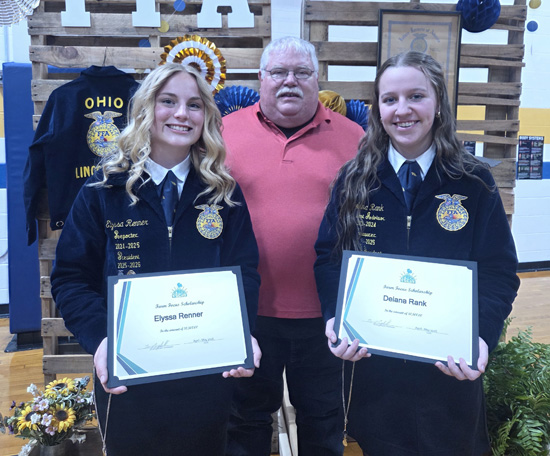
Renner will be a 2026 Lincolnview High School graduate planning to attend Wright State University Lake Campus in Celina. She plans to major in agribusiness and use her skills back in her home community.
Mount is a 2024 Lincolnview High School graduate attending the University of Findlay, majoring in animal science (pre-vet and equine studies). Her career goal is to be a large animal veterinarian.
Burenga is a 2025 Van Wert High graduate attending University of Illinois majoring in agricultural and biological engineering. Her career goal is to work in the agricultural industry.
Farm Focus Inc. was founded in 1974 to promote agriculture in Van Wert County and the surrounding area. It is their continued mission to assist Van Wert County students through a scholarship program that will enable them to pursue a degree in an agricultural related field.
Submitted information
REYNOLDSBURG — From farm to plate, the Ohio Department of Agriculture is offering financial support to businesses and producers through the USDA’s Specialty Crop Block Grant Program. The 2026 Specialty Crop Block Grant (SCBG) Request for Proposals officially opened on April 1.
Specialty crops are fruits, vegetables, tree nuts, dried fruits, and horticulture and nursery crops (including floriculture). A full list can be found on the USDA’s Specialty Crop website. Grant awards will range from a minimum of $25,000 up to a maximum of $150,000. Last year, Ohio organizations were awarded more than $710,000.
Through USDA’s guidelines, the following entities are eligible to apply: food and agricultural non-profit organizations, cooperatives, associations or commodity groups, universities, and research institutions that represent specific specialty crop sectors. Projects benefiting only one single private individual, company, or organization are not eligible to apply.
To apply, grant proposals must be emailed to SCBG@agri.ohio.gov by 5 p.m. Friday, May 1.
Detailed guidelines, including project requirements and eligibility can be found here.
POSTED: 04/02/26 at 8:26 am. FILED UNDER: Farm
Submitted information
Farm Focus Inc. was founded in 1974 to promote agriculture in Van Wert County and the surrounding area. It is their continued mission to assist Van Wert County students through a scholarship program that will enable them to pursue a degree in an agricultural related field.
Farm Focus Inc. is offering a minimum of two scholarships of $1,000 or more and may offer more scholarships at various amounts to Van Wert County resident high school seniors interested in majoring in an agricultural related program at a university or college. Full time students already enrolled in an undergraduate program in agriculture are also eligible to apply, and successful applicants from previous years can reapply again this year.
The applicant must be a Van Wert County resident. Minimum grade point is 2.5 on a 4.0 scale. Scholarship funds will be submitted directly to the educational institution by Farm Focus Inc. upon receipt of proof of enrollment or a copy of a tuition invoice.
Scholarship applications have been sent to nine area high schools where Van Wert County students may be enrolled, so please contact your high school guidance counselor, or agricultural education/FFA Instructor for your scholarship application. The application is available at the OSU Van Wert County Extension office at 1055 South Washington St., Van Wert, or email FarmFocusScholarship@gmail.com. The scholarship application is in a PDF file and MS Word formats and can be emailed or put on a jump drive. Questions should be emailed.
All completed applications must be emailed, mailed and postmarked or delivered in person no later than March 27, to the OSU Van Wert County Extension Office. The preference is to email the application.
VW independent staff/submitted information
INDIANAPOLIS (IN) – The United States Department of Agriculture has designated 28 Indiana counties as natural disaster areas due to drought and as a result, five Ohio counties – Darke, Defiance, Mercer, Paulding and Van Wert counties – are eligible as contiguous counties.
The natural disaster designation allows the USDA Farm Service Agency to extend emergency credit to producers recovering from natural disasters through emergency loans. Those loans can be used to meet various recovery needs including the replacement of essential items such as equipment or livestock, reorganization of a farming operation, or to refinance certain debts. The FSA will review the loans based on the extent of losses, security available, and repayment ability.
The loan application deadline is August 31.
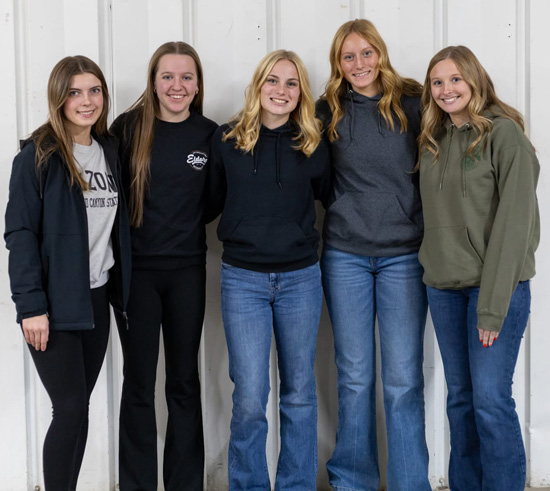
The Lincolnview FFA chapter had four of its members elected as officers to the Van Wert County Jr. Fair board. Shown above (left to right) are Lincolnview’s Jr. Fair board officers, Braylee Welker, secretary; Delana Rank, vice-president; Elyssa Renner, president; Gracie Schaadt, Vantage Career Center, and Alexis Hoaglin, treasurer. The Lincolnview chapter also has 22 active members on board. The members who attended participated in fun team-building activities and contributed ideas to the topics brought to the table. Photo submitted
By Emily Lichtle/Crestview FFA reporter
CONVOY — Crestview FFA is proud to announce that Dakota Thornell has advanced to the State Job Interview Contest, where she will compete in Division 5 on Friday, December 5, at the Ohio State Fairgrounds in Columbus.
Dakota has had an impressive season, earning second place at sub-districts, first place at districts, and first place in state prelims, securing her place among the top competitors in Ohio. Dakota explained that she was inspired to compete thanks to the encouragement of Mrs. Ericka Gibson, and she prepared through a practice interview with Principal, Ms. Mimi Myers. Thornell thaned Kerry Koontz for her CEO paper from the summer to help prepare her.
One of the most challenging obstacles Thornell faced during this journey was navigating the technology for state prelims. The most rewarding experience has been meeting other FFA members in the same CDE and learning from their advice and perspectives. She shared that she is both surprised and excited to advance to the state level and hopes to make Crestview proud. She also emphasized how valuable this competition is for building real-life job skills that will benefit her far beyond FFA.
Thornell thanked the community for their support, her FFA members for helping her prepare and celebrate her accomplishments, Mrs. Ericka Gibson for believing in her, and the FFA members she has met along the way who have helped her grow. Crestview FFA congratulates Dakota on her outstanding dedication and wishes her the best of luck as she competes at State.
By Emily Lichtle/Crestview FFA reporter
CONVOY — The Crestview FFA has announced this year’s Blue Jacket recipients from the Agriculture, Food, and Natural Resources class. This application is awarded to first year FFA members who submit a personal essay describing how FFA has influenced their life. This year, we are excited to recognize nine young men who earned their blue jacket, thanks to the generosity of local sponsors who continue to support agricultural education in our community.
Junior Bowen Ayers was selected by Kevin Wenninger of Wenninger Seed Service, Inc. Also selected by Wenninger were Dylan Cress, Brayden Hedington, Cody Mishey, and Bentley Scott. Evan Knueve and Corbett Roth were selected by Laura Hannum from Trillium Farms. Freshman Hudson Buuck was selected by Samantha Bluhm from the Van Wert County Farm Bureau, and Cale Carr was selected by Eric Grubaugh from Grubaugh Farms and Seed.
Each student wrote a meaningful essay describing how FFA has impacted their life or the lives of those around them. Below are a few highlights from several of the essays submitted.
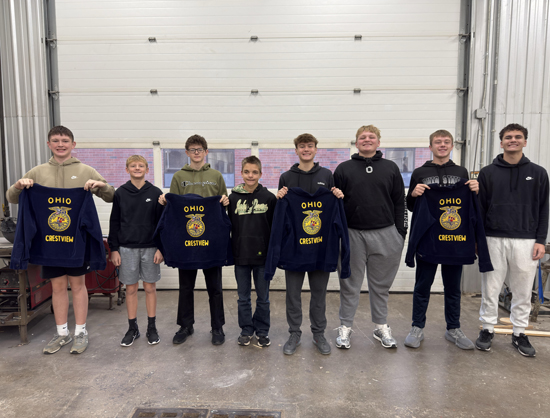
Bowen Ayers wrote about how agriculture has become a place where he can talk to others without feeling judged. He shared that wearing the FFA jacket would help him feel more included and connected within the chapter, and that the jacket represents a space where he can truly be himself.
Cody Mishey explained that while he is not as drawn to the agricultural side of FFA, he is excited to meet new people and expand his knowledge of agricultural machinery.
Bentley Scott highlighted that although his own FFA journey is just beginning, the organization has already had a meaningful impact on his family. In his essay,
Hudson Buuck wrote about how his brother’s positive experience in FFA inspired him to join, and he reflected on the friendships and opportunities that FFA members build together.
Crestview FFA congratulates all nine recipients on earning their first official blue jackets and extends sincere thanks to the sponsors who made this program possible. These jackets symbolize leadership, opportunity, and a bright future in agriculture for each of these young members.
By Cassidy Rank/Lincolnview FFA Reporter
15 members of our chapter had a blast in Indianapolis, Indiana, attending the 98th National FFA Convention & Expo from October 28- 31, accompanied by Crestview FFA and Parkway FFA. For many, it was a new experience in which they learned many ways to strengthen their leadership skills and become more engaged in the agricultural world.
The trip started with a tour of Unverferth Manufacturing in Kalida. Our members learned that the business has been family-owned since its inception and about the pros and cons of the machinery they use to produce their products. After, they made a stop at the Bob Evans Farms Manufacturing in Lima. Members went on a tour of their facility, getting a firsthand look at everything that is required to make their famous mashed potatoes and mac and cheese, which were offered in sample sizes to members. On the tour of the facility, members learned about the importance of food safety and proper sanitation. Next, we made a pit stop for lunch and made our way to Young’s Jersey Dairy in Yellow Springs, Ohio. Members enjoyed delicious ice cream and recreational activities, including an entertaining corn maze! Our first day ended at a cozy lodge in Oxford, Ohio.
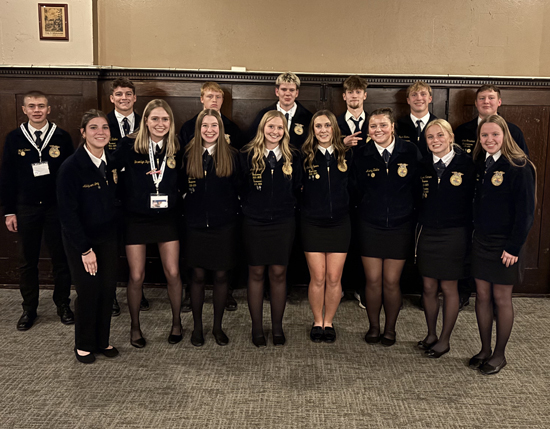
Members started the next day of the trip bright and early, as we toured Stockyard Packing Company in Oxford. We learned about the different equipment used and the process from the stockyard to our tables. The next stop was at Buck Creek Winery, where members went on a tour and got to see the grape vines they have grown for over 20 years. Then, we ended the second night of our trip at the FFA rodeo and had a fantastic time.
On Thursday, we attended the first general session of the 98th National FFA Convention and Expo and listened to a wonderful message from A’ric Jackson about overcoming hate and negativity. We had plenty of fun exploring different boutiques, career booths, and visiting college representatives. Later in the day, we attended the second general session, in which we experienced an opening ceremony completely in Spanish! We also heard from the U.S. Secretary of Agriculture, who delivered a passionate speech about those who are in the agriculture industry. We finished our evening dining at a German restaurant called Rathskeller. We enjoyed fellowship, great hospitality, ate popular German dishes, and had delicious chocolate cheesecake for dessert.
On Friday, the final day of our trip, we listened to Luke Jennings’ retiring address, “See a light, Be a light.” He shared inspirational stories and provided advice on leadership to take back to our chapter. We ended our time in Indianapolis with a final trip to the expo-center, then made our way back home.
Members who went on this trip experienced engaging tours and gained skills to bring home and lead our chapter.
Submitted information
The Van Wert Farm Bureau and Soil & Water Conservation District will co-host their annual ag banquet on Tuesday, August 5 at Life House Church in Van Wert.
The evening will begin with an election for two supervisors on the SWCD Board from 5-6 p.m., then dinner catered by Lock 16 at 6 p.m., and the meeting following.
This year’s speaker is Jolene Brown, a walking-talking spokesperson and champion for the people of agriculture. She’s a farmer in Eastern Iowa, contributor to Successful Farming magazine’s popular family business column, author of two books and an inductee into the prestigious CPAE Speaker Hall of Fame. Her worldwide audiences appreciate her fun-filled spirit and valuable information. She’s on a mission to share leading-edge best practices, appreciation, laughter and celebration to increase productivity, profitability and peace of mind. She’ll be speaking on the topic of transition farming.
There will be no charge for the meeting this year, however, RSVPs are required by Thursday, July 24, by calling the office at 419.238.9591 or emailing Becky at becky@vanwertswcd.com.
Submitted information
REYNOLDSBURG — The Ohio Department of Agriculture is thrilled to participate in a summer trade mission event highlighting the strength and diversity of Ohio’s agricultural industry.
Food Export-Midwest and Food Export-Northeast are hosting the second annual Summer in the Cities Buyers Mission, making a stop in Columbus in August.
The trade event is designed to connect Ohio food and agricultural suppliers with prequalified international buyers from around the world, offering them the opportunity to showcase their products. Representatives from 21 countries are expected to participate and provide information about exporting goods and particular markets. ODA will help secure local suppliers for the event through the department’s Agricultural Trade and Export program.
“By helping Ohio companies grow through exports, we increase the demand for quality, Ohio-grown products,” said ODA Director Brian Baldridge. “Events like this not only connect products to new markets, but also connect farmers to a stronger, more resilient future. This is a great opportunity for Ohio agriculture.”
Countries represented at the event include Aruba, Australia, Brazil, Cambodia, Canada, Chile, China, Fiji, Germany, Ghana, Guatemala, Hong Kong, India, Korea , Mexico, Nicaragua, Singapore, Taiwan, United Arab Emirates, United Kingdom of Great Britain and Northern Ireland, and Vietnam.
According to the ODA, food and agriculture is Ohio’s No. 1 industry, adding $124 billion to the economy and employing one out of every eight people. Ohio farmers grow or raise more than 200 different kinds of crops and livestock, and the state is also home to approximately 1,000 food processing companies.
In addition to Columbus, the Summer in the Cities will also stop in Chicago, Illinois, and Jersey City, New Jersey.
If your company is interested in participating, please contact Tim Sword, ODA’s Trade and Export Program Administrator at Tim.Sword@agri.ohio.gov or 614.563.1932. The deadline to register is July 2.
POSTED: 06/26/25 at 8:49 pm. FILED UNDER: Farm