







What’s Up at Wassenberg Art Center 3/9/11
What’s in a watercolor besides water?
By Hope Wallace
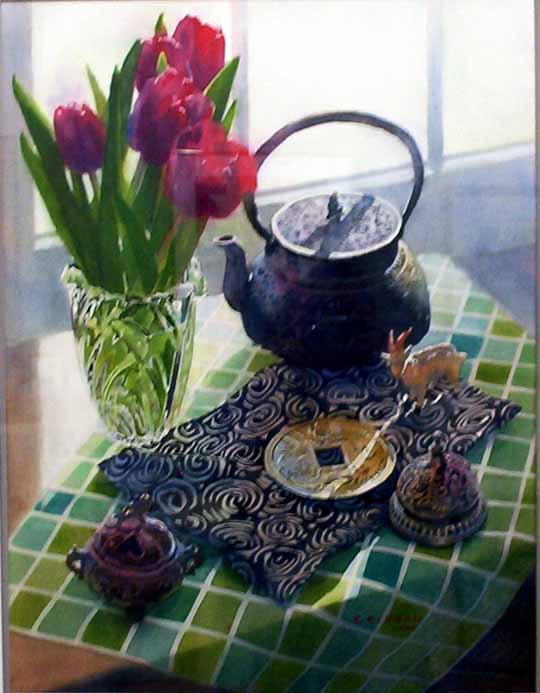
“Goat Tea”, a watercolor by Cynthia Allman of Medina, appears in the Ohio Watercolor Society Exhibit now on display at the Wassenberg Art Center.
“Watercolor” encompasses many mediums and techniques, and quite a few of them can be found in the Ohio Watercolor Society Exhibit which opened at the Wassenberg Art Center last Sunday. The exhibit includes a wide variety of paintings done with water media. This means that in all the works, water is used to thin the paint. In this show you will see paintings that use some of the following water media.
Traditional watercolors are known for their transparency; light goes through the paint and reflects off the paper to give a characteristic look to the painting. In pure traditional watercolor, the artist “reserves” or saves the white of the paper for the white areas of the painting.
Opaque watercolors such as Pelikan brand are similar to transparent watercolors but do not allow as much light to pass through. They can be layered to the point where no light passes through to the paper.
Acrylic paints are synthetic paints with a water base. They are fast-drying, lightproof and non-fading and can be used on any non-oily surface. They can be used like oil paints or thinned and applied transparently like watercolors. They can be thinned with water or special painting emulsions.
Gouache is French for permanent opaque watercolor. Designer’s colors and casein are forms of gouache. Also, the mixture of opaque white with transparent watercolors can be used to create a kind of gouache.
Casein consists of a binder made from a milk derivative (casein glue) combined with pigments. It dries quickly with a waterproof surface and can be varnished. It can be used on paper or illustration board, etc., but is too inflexible for canvas.
“Whiskey painting” is a specialty of the Whiskey Painters of America (WPA). This select painting group specializes in miniature watercolor paintings using whiskey, vodka, or other alcoholic beverages instead of water to thin their paints. We don’t think any of the pictures in this exhibit are whiskey paintings, but one of the artists whose work is displayed in this OWS show is a member of the WPA as well as the OWS.
So “watercolor” is more than just the sort of watercolors many people are familiar with. Visit the art center during the OWS exhibit and see the amazing things that can be done with water media! The show runs through March 27 and exhibit hours are 1-5 p.m. Tuesday through Sunday (closed Mondays). Admission is free.
The Wassenberg Art Center is located at 643 S. Washington St., Van Wert, Ohio. Contact us by phone at 419.238.6837 or email wassenberg@embarqmail.com. Visit the website at www.vanwert.com/wassenberg.
The tulip — a favorite in gardens and in art
By Kay Sluterbeck
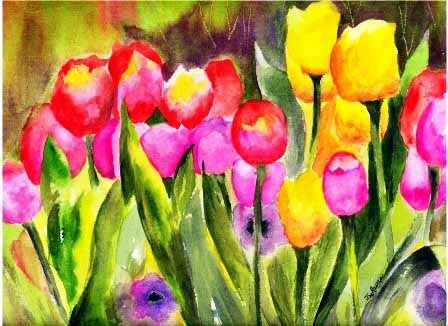
For hundreds of years the tulip has been a favorite subject for artists and photographers. The Old Dutch masters painted huge, spectacular still lifes featuring many varieties of tulips; many of today’s artists enjoy painting them, and tulips even feature as desktop wallpaper for computers. This beautiful flower has a long and fascinating history.
No one really knows where tulips originated. It can be found growing wild in North Africa, southern Italy, southern France, Turkey, China, Japan and Korea. Its most likely birthplace seems to be in central Asia, somewhere between China and the southernmost part of Russia. From there, the tiny tulip seeds probably rode the wind in enormous clouds of dust, traveling over the Himalayas and even as far as the Netherlands.
The flower quickly became a favorite of the Turkish sultans. Even before the rest of the world knew of the plant’s existence, experts in Turkey were searching for variations of the tulip. During the reign of Suleiman the Magnificent (1520-1566) tulip bulbs were being propagated to create a diversity of colors and shapes. The goal was elongated tulips with petals tapering to a point. The Turks first called tulips Café Lale, but they also called it “tulipan,” derived from “dalban,” meaning a turban.
Tulips took a long time to appear in the gardens of Western Europe, mostly because Turkish gardeners, harem guards, and harem residents were severely punished if they stole a tulip from the sultan’s garden. The tulip was very successfully kept as a secret, private pleasure for the lord and ladies of the harem. No flower was allowed to leave the garden, let alone a bulb.
In the 1500s the Flemish diplomat Ogier Ghiselin de Busbecq wrote about the beautiful tulips he saw in the court of Suleiman I, sultan of Turkey. His descriptions aroused the interest of Clusius, the head of the Imperial Physic Garden in Vienna, established by Emperor Maximilian II. De Busbecq somehow obtained tulip bulbs and seeds and brought them to Clusius along with instructions on how to grow them.
Especially in the Netherlands, the tulip quickly became a coveted luxury item and status symbol. Varieties were classified by groups; one-colored tulips of red, yellow, or white were known as Couleren, but the multicolored Rosen (red or pink on white background), Violetten (purple or lilac on white background), and Bizarden (red, brown or purple on yellow background) were most popular. These tulip bulbs would grow flowers with vivid colors, lines, and flames on the petals, the result of a tulip-specific mosaic virus.
As the flowers grew in popularity, “tulipomania” set in. Professional growers paid higher and higher prices for bulbs with the virus. By 1634 speculators began to enter the market. In 1636, the Dutch created a type of formal futures markets where contracts to buy bulbs at the end of the season were bought and sold. Traders met in “colleges” at taverns and buyers were required to pay a fee for each trade.
The growing popularity of tulips in the early 17th century caught the attention of the entire nation. Even the lowest members of Dutch society were involved in tulip trading. People sold or traded their other possessions to obtain tulip bulbs. By 1635, a sale of 40 bulbs for 100,000 florins was recorded. By way of comparison, a ton of butter cost around 100 florins, a skilled laborer might earn 150 florins a year, and “eight fat swine” cost 240 florins.
Prices for tulip bulbs kept escalating until by February 1637 it was impossible to find buyers willing to pay increasingly high prices for bulbs. The demand for tulips collapsed, and prices plummeted. Some traders were left holding contracts to purchase tulips at prices now ten times greater than those on the open market, while others found themselves with a stock of bulbs now worth a fraction of the price they had paid.
POSTED: 03/09/11 at 2:14 pm. FILED UNDER: What's Up at Wassenberg?