







County takes next step on projects
DAVE MOSIER/independent editor
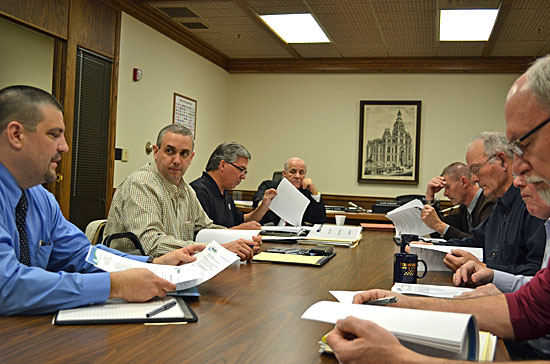
The Van Wert County Board of Commissioners appear poised to go forward with an energy savings project that would also allow for completion of a restoration project for Van Wert County Common Pleas Court.
The bulk of the project – approximately $350,000 – would be for renovating the Common Pleas Court area, including judge’s chambers and stained-glass work on the dome above the courtroom. Judge Charles Steele has most of the money needed for that project, but the county wants to renovate the entire third floor of the Courthouse, including HVAC renovation and electrical refitting.
Total cost of that project would be $525,000, but a plan that would include retrofitting lights in several county facilities, including the Courthouse, County Annex, Sheriff’s Department and County Correctional Facility, would allow for energy savings of more than $10,000 a year and also allow the project to be funded with a note that would be paid through the energy savings.
The commissioners, Judge Steele, Bruce Miller and Christopher Monnin of Minster-based Garmann/Miller Architects-Engineers and Chris Johnson, project administrator for Energy Optimizers USA, also attended the meeting to provide their input on the project.
Miller and Monnin mostly talked about the third-floor renovation project, which is something their firm would be involved in designing, while Johnson provided details about the lighting retrofit that would be done under state legislation that allows local governments and schools to implement facility upgrades and pay for the projects with energy savings over a period of time from 10 to 30 years.
The legislation provides a number of financing benefits. Those include:
The notes taken out in conjunction with such projects do not count against an entity’s overall indebtedness, and an entity does not have to pass a levy or bond issue to obtain loans under the state legislation.
The commissioners, who all favor doing the project, will be looking for a financial institution that would float the notes needed to finance the project. When financing is obtained, Johnson said his firm would do a more detailed energy audit that would allow for payback of the cost of the project over a period of approximately 18 years.
Prior to HB 420, Johnson noted, the county couldn’t have done the project because older legislation required an energy payback within 10 years. Now, an entity has up to 30 years to pay back the cost of such projects.
Johnson said Energy Optimizers also tried to save government entities additional expenses by using local vendors, when possible, as well as maintenance staffs to do some of the work.
Johnson noted that upgrading lighting would allow for substantial energy savings by going to lower-wattage lighting, without sacrificing brightness.
The judge noted that renovations are badly needed on the third floor of the Courthouse, since the current heating system is badly regulated, resulting in temperatures that go too high during the winter, which leads to having to turn on the air-conditioning system for an hour at a time to cool down the area.
Commissioner Clair Dudgeon said now was likely a good time to do the project, since the special project money might not be there down the road, with the current state budget woes, while interest rates are very low right now for the financing part of the project.
Commissioner Gary Adams spoke for his colleagues in that, contingent on obtaining appropriate financing for the project, the commissioners were interested in going forward with the renovations and energy saving project.
Miller said the next step of the project is to get Energy Optimizers administrative staff in to research the project to come up with more detailed information for the project and he would also get Garmann/Miller’s contract to the county for the commissioners’ review.
POSTED: 03/18/11 at 3:41 am. FILED UNDER: News