







Wassenberg and Week of Young Child
By Hope Wallace
One of the most important things in a young child’s life is imagination. It’s essential to encourage children to use their wonderful gifts of imagination and creativity so that they grow up to be creative adults who can think outside the box and solve problems in unique ways.
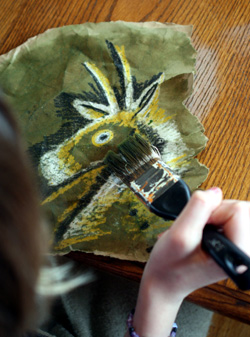
To support the upcoming Week of the Young Child, we’ll be providing an art class for a group of young people ages 8-10 at the YWCA on April 14. The subject will be “Cave Art.” Prehistoric art is remarkably sophisticated and in some ways very much like the modern art of today. The group will be shown a presentation of cave art from various locations throughout the world including North America. This is truly an amazing and complicated slice of art history.
Following the presentation, kraft paper (tough, usually brown paper made from chemically treated wood pulp, like paper bag paper) will be rendered with crayons. The paper will be crumpled and a watercolor wash applied. The crayon acts as a resist and some very unique artwork can result using this technique.
In other news, we encourage you to visit the Ohio Watercolor Society Exhibit, which continues through March 27, Tuesday-Sunday, 1-5 p.m. The show is sponsored by Central Mutual Insurance Company and Purmort Brothers Insurance agency.
The Wassenberg Art Center is located at 643 S. Washington Street in Van Wert. Contact us at 419.238.6837 or wassenberg@embarqmail.com. Information about current classes and exhibits is on the calendar at our website, www.vanwert.com/wassenberg.
Fantasy art lets artists create own worlds
By Kay Sluterbeck
When I was a child, home computers didn’t exist, there were no cell phones, Ipads, or Blackberries, and my parents didn’t plunk me down in front of the television to watch cartoons on Saturday morning. Sure, I had my fill of such programming too, but my mother would more likely hand me paper and pencil and say “Go draw me something.” So I’d sit at the little desk Grandpa had made me and draw. I spent hours creating whole worlds, sometimes
involving little animals in the forest, sometimes set in space, sometimes set in ancient Egypt or the Maya culture.
My parents were letting me develop my imagination. I had to deal with the real world every time I went out of the house. Drawing imaginary things gave me my own world to escape to.
This kind of imaginative drawing done by adult artists is known as “Fantasy Art.” Fantasy Art is a variation of humanity’s long history of storytelling. Every culture tells stories filled with heroes and heroines, monsters, strange lands, and exotic cities. Through these tales, whether spoken or painted, we can learn about ourselves, our relationships, and the problems we face in life.
Fantasy art done to amuse or to illustrate has been around for centuries.
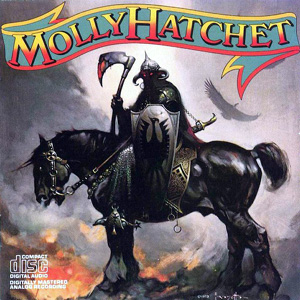
For a time, fantasy art fell into disuse. But in the early 1960s, probably one of the greatest fantasy artists of all time, Frank Frazetta, kicked off today’s fantasy art movement with his covers for Ace paperback books and popular southern-rock band Molly Hatchet album covers. He and Roy G. Krenkel created the kind of stunning fantasy art that hadn’t been seen in print for decades. These two artists were inspired by the great 19th century paintings and illustrations, and their art was built on the Academic foundation of strong drawing, design, color and composition. For the most part, these fundamental skills were no longer taught in art schools. In fact, the art school establishment of the time ridiculed Academic skills.
Today, in part because of the revival of interest brought about by the work of Krenkel and Frazetta, there are art schools that once again teach Academic art. Being a fantasy artist in today’s world requires the knowledge of a great landscape painter, the exactness of an imaginative architectural artist, and rock solid draftsmanship when it comes to human figures and animals.
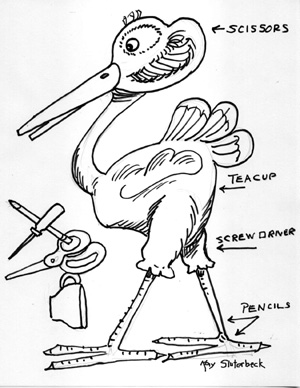
Fantasy artists also need to be able to create and draw things that have never been seen in the real world. How do they get their ideas? Some simply have great imaginative skills. Others get ideas by manipulating things from the real world. For example, distorting and combining parts of a lizard, a bat and a bird can lead to a picture of a frightening feathered dragon. Playing around with elements from ancient architecture helps to create a vision of the lost world of Atlantis.
If you’d like to try creating fantasy art, you could begin by inventing a strange and exotic creature. For inspiration, go through the house and pick up a few items — pliers, scissors, screwdrivers, teapots, etc. First sketch each piece separately to get familiar with them. Then try combining them into an animal or bird. Screwdriver legs, a teapot body, and a pliers head, perhaps! Make several sketches of your found-object creature, smoothing lines and changing details, adding scales, spikes, or feathers, until you are satisfied. Voila! You’ve made fantasy art!
POSTED: 03/23/11 at 1:21 pm. FILED UNDER: What's Up at Wassenberg?