







9-1-1 dispatchers prepared for anything
CINDY WOOD/independent feature writer
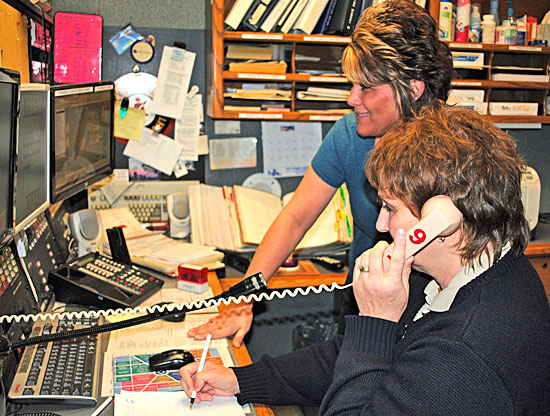
Calm, cool and collected. Van Wert County’s 9-1-1 dispatchers have to be all three, and then some. Dispatchers are a critical link in getting assistance to an emergency caller, and the nation celebrates these men and women during National Telecommunicators Week, April 10-16.
Even in a smaller county such as Van Wert, getting enough information from a 9-1-1 caller can be a difficult experience. “You really never know what you will get on the other end of a 9-1-1 call,” said Shelly Smith, who’s been a dispatcher with the Van Wert City Police Department for 10 years. “You could get someone screaming and yelling that their baby is not breathing. It could be a domestic dispute. It could be a report of a motor vehicle accident. That’s what 9-1-1 is about,” Smith said.
Unfortunately, though, there are callers who don’t quite understand what constitutes an emergency. “We’ve gotten calls from people who ask what the phone number to the license bureau is, because they can’t find the number,” Smith said. “Those types of calls are frustrating because 9-1-1 is for emergencies.”
Smith, whose father served in law enforcement, received her first experience in dispatching as an auxiliary dispatcher with the Van Wert County Sheriff’s Department. “At that time, they had an auxiliary for dispatchers who would fill in whenever they were needed,” Smith said.
Dispatchers serve as an important first step in getting emergency response to someone who needs help. It’s a stressful job, and one that dispatchers take very seriously.
“Dispatchers exhibit professionalism and reassurance in stressful situations,” said Van Wert County Sheriff Stan Owens. “We are very proud of the service our communications officers provide our residents on a continuous basis.
“Communications can be a high stress job at times, dealing with life and death situations,” Owens added. “It’s during these times that communications personnel show their true professional abilities.”
Staying calm in an emergency situation is exactly what dispatchers are trained to do. Dispatchers must know how to handle any type of call, ranging from domestic situations, homicides, or a person who has stopped breathing. Dispatchers must pass a test and also undergo updated training every two years. In addition, each individual department has its own policies and procedures that must be followed.
Like any other job, much experience is also gained on the job. “A lot of it is on the job training and learning from each individual situation,” Smith said.
That was never more evident to Smith when, after just a year on the job, an F-4 tornado barreled through the county in November of 2002. “I can’t even begin to tell you how many calls we took that day,” Smith said. “We had every dispatcher in here taking calls or helping people from the community who were coming in,” she added. “That day was completely nerve-wracking. At the time, it made me really wonder if this was what I wanted to do.”
It was. Smith has been sitting behind the desk for a decade now, and each day brings with it a new learning experience. Aside from F-4 tornadoes, though, dispatchers need to be prepared to provide instruction and guidance during a myriad of emergency situations that might include chokings, stabbings, eye injuries, electrocution, seizures, overdoses or a number of other situations that require emergency response.
“When you first answer the call and someone is yelling and screaming, you really need to get control of the caller,” Smith said. “You have to set the tone right away.
I always talk to them as if they’re a family member, and it’s really a comfort to them,” she added. “Basically, we just go through steps and procedures that we relay to them to try to administer help until the squad gets to the scene. I stay on the phone with them until help arrives, because three minutes can really seem like forever when you need help.”
Nobody recognizes the value of dispatchers more than Kim Brandt, the county 9-1-1 coordinator. Brandt stressed that the availability of 9-1-1 to a community is a tremendous benefit. “It gives the public direct assess to a PSAP (public safety answering point), which is responsible for taking appropriate action,” Brandt said. “The benefit is reduced response time by emergency agencies.”
And in emergencies, seconds count, Brandt said. “A reduction of one minute in response time for a rescue service lowers the death rate in heart attacks, accidents and injuries, and probably saves countless dollars in fires, while also contributing to a high apprehension of criminals,” she noted.
Van Wert City Police Chief Joel Hammond said the community is fortunate to have dedicated individuals waiting to take their 9-1-1 calls. “We’re extremely lucky to have such a great group of dispatchers and such a fine staff of competent and dedicated professionals working in our communications center,” he said.
Smith agreed, and added the department is like her second family. “They’re like a group of older brothers I never had,” she said. “We’re like family, and you have the goods and the bads with that, but I know I appreciate everyone I work with.”
POSTED: 04/11/11 at 12:59 am. FILED UNDER: News