







Former youth pastor’s sentence upheld
DAVE MOSIER/independent editor
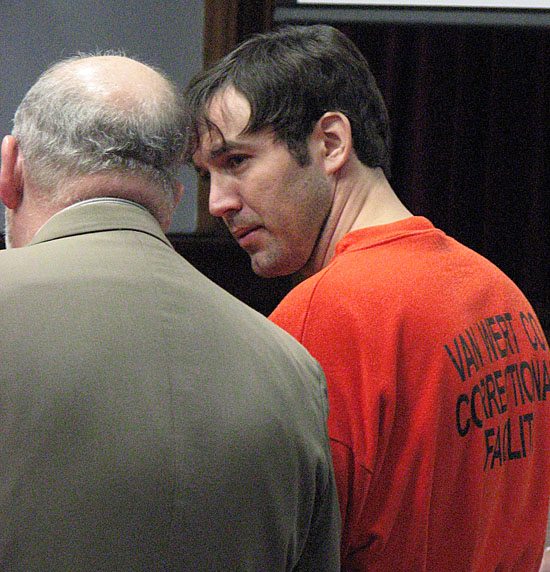
A former Van Wert youth pastor sentenced to 12 years in prison for having sex with young girls in his church youth group had that prison sentence upheld on appeal.
In a decision released Monday, the Ohio Third District Court of Appeals upheld a prison sentence handed down to Benjamin R. Boysel, former youth pastor at Trinity United Methodist Church. Boysel had pleaded guilty to four counts of sexual battery, all felonies of the third degree, and was sentenced to a total of 12 years in prison — four years on two counts and two years on the other two counts, with the sentences on each count to be served consecutive to the others. The charges stem from the former youth pastor’s having sex with four girl members of his youth group ages 14-16.
Boysel had appealed the prison sentence on two assignments of error, the first being his denial effective assistance of counsel and the second that the trial court’s sentence was not in keeping with the principles and purposes of felony sentencing.
Through his latest attorney, Dillon Staas, Boysel claimed that he relied on assurances from W. Edward Hatcher, the attorney who represented him prior to and through his sentencing, that a guilty plea would result in a prison sentence of less than 10 years, making him eligible for early release from prison.
The appeals court decision, written by Judge Vernon Preston, said Boysel’s argument lacks merit.
“The record lacks any evidence of counsel’s assurance that the trial court would sentence him to less than 10 years imprisonment,” Judge Preston wrote, adding, “The record does demonstrate, however, that Boysel was aware that the (prosecution) was recommending 12 years of incarceration.”
The appellate judge went on to say that Judge Charles D. Steele, in sentencing Boysel, had advised the former youth pastor that he faced a possible 20 years of incarceration on the charge, and that he would be ineligible for judicial release if he was sentenced to more than 10 years of incarceration.
At the time, Boysel noted that he had discussed the change of plea with his attorney and was satisfied with his attorney’s representation. He also said he had not been induced to change his plea by any promises.
“After reviewing the record, we cannot conclude that trial counsel was ineffective at the sentencing hearing,” the decision noted, adding that Boysel’s trial attorney had stressed his client’s lack of a previous criminal record, argued that the victims had induced or facilitated the offenses and stressed that Boysel had never used any threat of physical harm to the victims.
According to the appellate decision, Boysel’s defense attorney also highlighted positive portions of the presentence investigation, such as his client’s previous military service and ministry experience.
“Aside from this, Boysel has failed to demonstrate that the result of the proceedings would have been different had trial counsel made a more exhaustive statement in mitigation,” Judge Preston concluded.
As to Boysel’s second assignment of error, Judge Preston stated that, to overturn a trial court’s sentence, there must be “clear and convincing evidence that the sentence is unsupported by the record; the sentencing statutes’ procedure was not followed or there was not a sufficient basis for the imposition of a prison term; or that the sentence is contrary to law.”
Such evidence was not included in Boysel’s appeal, according to the appellate decision. “After reviewing the record herein, we cannot conclude that the trial court erred in sentencing Boysel to an aggregate of 12 years imprisonment,” Judge Preston stated in his opinion.
The appeals court judge added the fact that Boysel was married at the time of the offenses, that many of the offenses against Boysel occurred when the then-youth pastor hosted overnight stays for members of his youth group at his home and that the victims have suffered severe psychological harm as a result of Boysel’s actions.
“Many of the victims stated that they have left their faith or question their faith, view men as predators, have endured strained relationships with their friends and family, have had doubts about having future relationships and their self-worth, have endured flashbacks and dreams and question the motives of adults in positions of authority,” Judge Preston wrote in his opinion.
Judge Richard Rogers concurred with the majority opinion, while Judge John Willamowski also agreed, but included in a separate statement that he feels the appropriate standard of review of challenges on sentencing is whether the trial court abused its discretion.
POSTED: 04/13/11 at 3:23 am. FILED UNDER: News