







Operation Street Smart provides drug info
DAVE MOSIER/independent editor
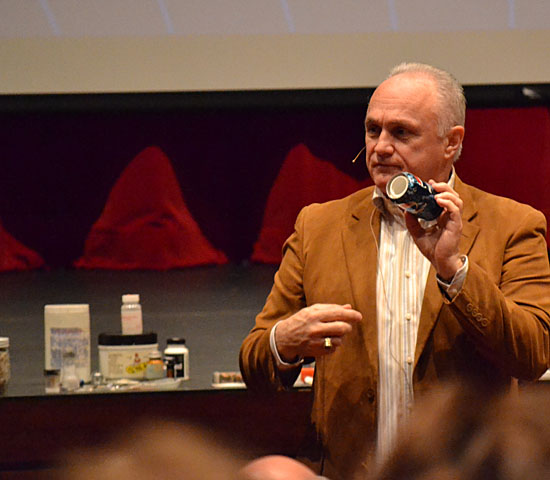
A group of more than 200 area teachers, law enforcement representatives, social workers, and first responders got clued in to what kinds of drugs are being sold — and used — by young people and others.
The people who provided the information were part of Operation Street Smart, a program developed by the Franklin County Sheriff’s Department to provide public education about various drugs being abused by people – especially young people. The program is also associated with the Franklin County DARE program.
Three of those instructors, Lt. Steven Tucker, Lt. Shawn Bain and retired Sergeant Michael Powell, who all work or worked for Franklin County Sheriff Jim Karnes, were at the Niswonger Performing Arts Center on Monday to talk about various drugs, their effects, and what to look for if drug use is suspected.
The information was provided by Lt. Bain, who commands the Franklin County Sheriff’s Department’s Special Investigations Unit (SIU) — a unit that includes 18 officers and conducts all undercover investigations done in Franklin County — and also the Franklin County/HIDTA Drug Task Force, and Sgt. Powell, who retired in March 2006 after 36 years as a police officer, 20 of those years as a member of the SIU.
According to information provided by Operation Street Smart, the program’s aim is to “educate community partners, social workers, teachers and anyone with a nexus to children about current drug trends, terminology and paraphernalia.”
The four-hour training seminar was comprehensive, ranging from the more common drugs, such as marijuana, heroin (Van Wert County’s biggest problem), cocaine, crack cocaine, and methamphetamines, through DXM (found in cough medications); prescription drugs such as Ritalin, Xanax, Oxycontin, Methadone, and Vicodin; salvia divinorum; an opiate substitute from Southeast Asia called kratom, “date rape” drug GHB; Ecstasy; psilocybin mushrooms; PCP; and a drug called khat (pronounced cot) that is now coming into the United States from East Africa and southern Arabia. Drug abuse known as “huffing” — which involves breathing in chemicals included in aerosol cans — was also discussed.
There was also information on drug paraphernalia and the terminology used by drug abusers.
The Operation Street Smart program also included information on one of the newest drug problems, known as “bath salts” and “plant food,” which are hallucinogenic chemicals that are now showing up in communities such as Van Wert (see Law Enforcement section on the Statistics Page for one incident).
“The information you’re going to get today is going to affect you in many, many ways,” said Lt. Tucker, who is the Franklin County DARE officer, adding that his fellow presenters are “walking encyclopedias” of information about drugs and drug-related activities.
The program began with depressing statistics on drug use in the U.S. “We consume more dope than any other country in the world,” said Sgt. Powell, adding those numbers include 50 percent of the world’s cocaine and 60 percent of all illegal and illicit drugs, despite the fact that the U.S. comprises just 5 percent of the world’s population. “Because we abuse more than any other country in the world, we have more people dying than any other country in the world, we have more people addicted than any other country in the world, we have more kids using than any other country in the world.”
“If you learn anything from us, understand this: It’s a business; like any other business, it’s about manufacturing, marketing, packaging, distribution, cash flow, competition,” he added.
Sgt. Powell also talked about the ways drug users hide their drug use from others, including parents, and the often ingenious devices, among them hollowed out soft drink cans and other common, household items in which drugs can be stored, and pens, ChapStick dispensers and even highlighter pens that can be used as drug pipes. There was also a fake cell phone confiscated from a drug dealer that had a digital scales hidden inside to weigh drugs for sale.
The program provided examples of different types of drug paraphernalia, as well as items used in the manufacture of some drugs, such as methamphetamine. The officers also went into how abusers of over-the-counter cough medications, such as Robitussin, combine the medications with Jolly Rancher candies and light soft drinks such as Sprite to make a drinkable drug concoction.
The officers also discussed the history of drug use in the U.S. and terminology associated with various types of drugs, including those used in music listened to by today’s young people, while a portion of the program focused on how drugs are transported into the United States and how the international drug cartels operate.
There were many shakes of the head from those who attended the seminar as they inspected some of the items used to store and use drugs without the knowledge of parents and others.
The most dangerous drug covered by the program? Ironically, it’s one that’s legal to use in the U.S. if a person is old enough: alcohol.
Noting that alcohol is the No. 1 drug of abuse in the U.S., the presenters added that 65 percent of young people get liquor from family or friends, and that alcohol results in more deaths than all other drugs combined, including 5,000 deaths annually as a result of underage drinking (1,900 of those from motor vehicle accidents).
POSTED: 04/26/11 at 4:35 am. FILED UNDER: News