







Show preparations have some new twists
By Hope Wallace
There has been plenty of activity here at the Wassenberg Art Center over the last couple of weeks! In addition to our current double exhibit “The Art of Therapy” and “It’s in the Cards” we’ve been preparing for our 55th annual June Art Exhibit. This exhibit has a longstanding tradition with The Wassenberg Art Center since its inception in the mid 1940s. The call for artists has gone out in the mail with a new look, judges have been confirmed and volunteers are set to work on entry day and jurying day.

Entries will be taken on May 21 and 22 from 1-5. If you’re an artist age 18 or older and would like to enter your work, you can download the prospectus(rules, entry forms and artwork labels) from www.vanwert.com/wassenberg, or you may call to request one by mail. Be sure to provide your name and mailing address. A reminder: this is a juried exhibit, which means that jurors will select the pieces to be displayed. Entry does not guarantee exhibit.
The show reception is being planned, with some new twists. This year instead of the typical Sunday opening reception, we will open the show to the public on June 5 — but instead of holding the reception that day we are planning a Saturday evening cookout party and awards ceremony, open to the public, on June 11 from 5-9 p.m.
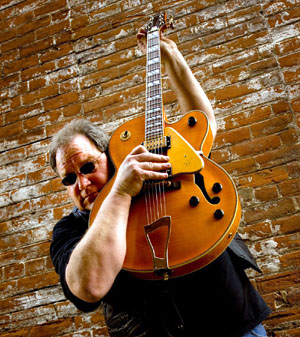
June is the perfect month for gathering outside and we’ve gone a step further and added musical entertainment by the talented John Reichle, guitarist. John hails from Montpelier and has been entertaining audiences with his unique style. We hope to see you at this party, which will also help to honor the 50th anniversary of building the Main Gallery addition to the original Wassenberg Home.
A reminder — there are still openings in the Watercolor and Mixed Media class to be held on Tuesday evenings in May. Visit our website calendar for information, or contact the art center.
I hope you will visit the Wassenberg Art Center often to join with us in enjoying art of all kinds. Our current exhibits, “It’s In the Cards” and “The Art of Therapy” focuses on two very different types of art, both of which encourage interaction. These shows, sponsored by Vancrest Health Care Center, will run through May 7. Exhibit hours are 1-5 p.m. Tuesday through Sunday (closed Mondays) and admission is free.
The Wassenberg Art Center is located at 643 S. Washington Street in Van Wert, Ohio. Contact us by phone at 419.238.6837 or by e-mail at wassenberg@embarqmail.com. Check the calendar on our website, www.vanwert.com/wassenberg, for current activities.
Dedini’s cartoons reflected his love of life
By Kay Sluterbeck
Photo caption: Cartoon by Eldon Didini.
(Continued from last column)
In 1959, cartoonist Eldon Dedini began working for Playboy magazine — an association that would last 45 years. Dedini’s cartoons became almost synonymous with the magazine because of their unique look and sophisticated humor.
Unlike almost all other cartoonists, Dedini thought in color rather than in line when he created a cartoon. Instead of thinking of color as just something added to a drawing, he clearly saw his cartoons as paintings with volume and depth. Although his line work was exceptional, his cartooning process didn’t depend on linear draftsmanship. His principal color medium was watercolor. He handled its challenges with great skill and obvious joy.
Dedini began his cartoons by making a quick, painterly rough drawing. Then he did the whole drawing again in chiaroscuro (the rendering of dark and light objects) using charcoal and wash. After this middle step, he did a final, detailed drawing and finished it in full color.
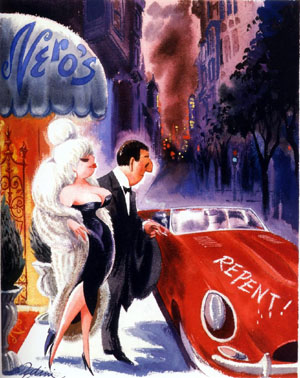
His cartoons encompassed a wide range of subjects, from religion to sex and everything in between. His interests included food, wine, people, humor, history, travel, family, sex, beautiful women and the outdoors. All these interests are reflected in Dedini’s cartoons. In scenes where satyrs romp with nymphs, the backgrounds could stand on their own as gorgeous nature studies. Voluptuous women draped with furs climb into perfectly detailed sports cars parked in brooding cityscapes. In a cartoon featuring Noah’s Ark, the ark and all the animals are brilliantly painted, and the weather — a stormy sky with just a few raindrops beginning to pelt down — is as well-rendered as a museum-quality painting.
Dedini’s art studies gave him an interest in the Old Masters, and it isn’t surprising that the voluptuous women he drew for Playboy were sometimes referred to as “Rubenesque,” after Peter Paul Rubens, the brilliant 17th century Flemish painter. The comparison involves not only Ruben’s well-rounded women but also his brilliant use of color and the lively flow of his compositions and figures — things that are also strongly apparent in Dedini’s work.
In an interview, Dedini commented, “I think plump girls are humorous — they’re more apt to be in real life. You get a Vogue model and I don’t think she’ll ever be funny.” Dedini’s cartoon females are all built more like Sophia Loren and Marilyn Monroe than Twiggy or Jennifer Aniston.
Although Dedini was known for his bawdy Playboy cartoons, in his own relationships he was very conservative. He met his wife, painter Virginia Conroy, while they were both studying art in Los Angeles. Their marriage lasted more than 60 years.
Not all his work consisted of beautiful babes and topical humor. For nine years, his cartoons were the centerpiece of a campaign for Mann Packing Company’s broccoli. A 2005 retrospective show on his career in his former home town of Salinas, Calif., was aptly called “From Babes to Broccoli.” Dedini wasn’t thrilled with the show’s title, but as a professional humorist he said, “It’s all right. It works.”
Dedini’s cartoon roughs were so well conceived and drawn that editors had little to edit. Lee Lorenz of The New Yorker magazine said of Dedini, “He was tough to edit because he didn’t need much editing. I never asked him to redraw, which at The New Yorker is quite unusual.”
Dedini himself downplayed the illustrative side of his art, saying millions of people can draw but a good gag (the caption that distills the drawing’s humor) is the most difficult part of cartooning.
“That’s not true,” Lorenz said. “While a million people can draw, very few can cartoon well. To be a cartoonist you have to be a stylist, and that’s not easy to come by. It transcends any technique.”
Eldon Dedini died of cancer at age 85 in January 2006. He was still meeting Playboy deadlines, and his work was appearing worldwide — as it had for over 60 years.
POSTED: 04/27/11 at 1:12 pm. FILED UNDER: What's Up at Wassenberg?