







Artism
By Hope Wallace
What is that? Artism? The Art of Therapy and Art of Trading Cards exhibit closed a week ago, but Cleveland filmmaker Richard Walsh of Vision Media and Marketing wasn’t finished with it quite yet. “Artism” is a term coined by Richard when he shot a short video last year showing some of the adaptive techniques used for easing art processes for artists with autism.
This video, created for an art exhibit opening at 20 North Gallery in Toledo, opens with some hanging ceramic bird feeders swinging back and forth on their rail while a man sitting at a desk rocks in the background. The word “autism” shows up on the screen. As the man begins to paint a picture, the word “Art” comes in from the side and combines with the word autism to spell “Artism”. Simultaneously, the man in the background stops rocking to concentrate on his work. In a few seconds of motion picture, the basis of the video is brought to the forefront. If a picture is worth a thousand words, is a video worth tens of thousands?
This past Saturday, Richard and his mother Cora Walsh visited the Wassenberg Art Center with a small film crew. Over this past year, the Walshes have been developing a full-length documentary illustrating the positive affects of art on persons with autism. Richard and his business partner Don handled the footage, storyboard and sound with Cora working as film producer. Part of the footage was of the artwork here at the art center and of a second exhibit currently featured at the Niswonger Performing Arts Center. The remaining time was used for interviewing me regarding techniques developed to ease the creative process for artists with autism. These techniques covered areas of painting, drawing and ceramics.
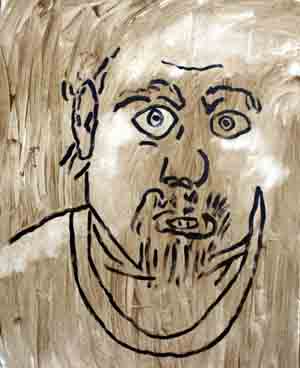
Why would a 29-year old filmmaker choose such a subject and dedicate so much time and effort to it? Richard’s younger brother, Cora’s son Conor, is one of the artists featured in both the short video and in the documentary, because Conor has talent. Conor also has autism. Conor creates paintings, drawings and ceramic sculptures of fish, frogs, and turtles (so far). Art is his work, vocation and sometimes his voice. When viewing Conor’s self portrait you may get a small sense of what it feels like to view the world through his eyes.
I had the honor of working with Conor at Bittersweet, Inc. for over a year before taking the executive director position here at the Wassenberg Art Center. Conor and several other artists at Bittersweet, Inc. taught me much about the human condition and what it means to be human. Humanity is diverse in millions of beautiful ways. The artwork featured in this documentary will illustrate exactly that. All you have to do is look.
The film contains interviews with several artists who have autism and what art in their lives means to them. It should be available towards the end of the year and I am looking forward to that email from the Walshes saying, “It’s done!” This is a rare opportunity to see what challenges persons with autism face on a daily basis.
The Wassenberg Art Center is located at 643 S. Washington St., Van Wert. Our next exhibit is the 55th Annual June Art Exhibit, opening to the public on June 5 and running through June 25. For information about the art center and its activities, visit www.vanwert.com/wassenberg or call 419.238.6837.
The Prisons of Piranesi
By Kay Sluterbeck
In 18th century Venice, there wasn’t really much opportunity for architects. The country could already be called an architectural museum. However, Giovanni Battista Piranesi (1720-1778) sometimes listed himself as “Venetian architect.” This doesn’t begin to describe him, although he built one church in Rome and published books of architectural history and theory.
Born in Mogliano Veneto, then part of the Republic of Venice, Piranesi acquired an interest in Latin and ancient civilizations from his brother. He studied as an architect under his uncle, a Venetian engineer, but eventually moved to Rome where he studied the art of etching and engraving. Following this he collaborated with pupils of the French Academy in Rome to create a series of “vedute” (views) of the city.
Piranesi soon became famous for his etchings of Rome, which he sold to tourists from his shop near the Spanish Steps in Rome. As another attraction for tourists, he dug up bits of ancient Roman sculpture and put them together to make imposing objects that one could imagine gracing Nero’s palace. He sold these as “restorations,” and the most famous of them is known as the “Piranesi Vase,” created in 1776. (Today, museums aren’t quite sure what to do with these oddities.)
The remains of ancient Rome truly excited Piranesi. He had a knack for accurately visualizing the missing parts of deteriorating ancient structures. This, combined with his masterful skills in etching and engraving, brought him fame for his etchings of both contemporary and ancient Rome. But Piranesi is best remembered for his amazing etchings of imaginary “prisons” — the “Carceri d’Invenzione”.
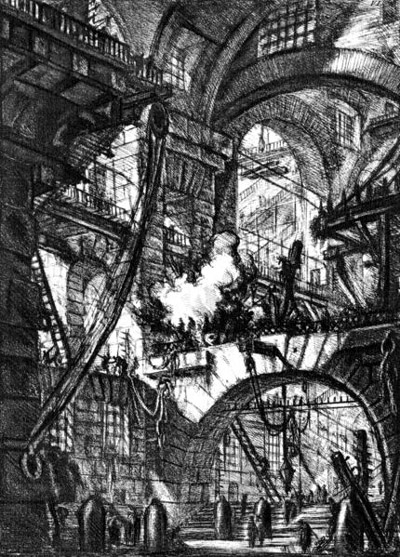
He began etching the Carceri in 1745. The first series consisted of 14 light, somewhat sketchy-looking etchings. The original prints were 16 x 21 inches. For the second publishing in 1761, he reworked all the etchings and two more were added. The second series of prints were darker, more detailed and more mysterious, as Piranesi became more passionate about showing the mood and complexity of his fantasized prisons.
Piranesi’s imaginary prisons were vast, Gothic halls filled with strange engines and machinery. These prisons are a place for the imagination to wander. They could not possibly exist in real life — they contain strange anomalies, including a staircase that exists on two planes simultaneously. Wheels, cables, levers, pulleys and catapults draw the viewer’s eye around the picture, making us feel that we are groping our way up through a huge maze. Nothing is logical. We find a staircase and follow it upwards, only to find that it suddenly terminates in a drop-off and we must climb a rope; and eventually stairs, ropes, and pulleys are all lost in the vast gloom of the upper halls.
In most of these pictures, actual punishment is suggested rather than shown. A few prison guards — or they might be prisoners doing forced labor — are shown digging a grave in the middle of a prison. There are glimpses of torture — a man being pulled on a rack, naked figures chained to posts; but high above them seems to be a musician playing the fiddle. Even higher, spectators are gathered on a walkway. It’s impossible to tell who is who; are these people guards, prisoners, or visitors? Perhaps everyone in this place is a prisoner.
The most disquieting thing about the prisons Piranesi depicts is that they are totally pointless. The architecture is magnificent and awe-inspiring, obviously hundreds of people have labored to build these prisons, but nothing seems to have a real purpose. Even the punishments seem relaxed, almost as if the prisoners and the torturers are in mutual agreement. We get the impression that the prisons extend for hundreds of miles and this colossal pointlessness goes on indefinitely.
Ever since they were published in the 1700s, Piranesi’s prison pictures have inspired writers, designers and architects. As early as 1760, a spectacular opera set copied one of Piranesi’s prison spaces. Edgar Allen Poe was a huge fan of Piranesi’s work, and the Carceri etchings inspired him to write “The Pit and the Pendulum.” Elements of Piranesi’s prisons appear in films from “Metropolis” to “Blade Runner” — even the moving staircases at Hogwarts School in the Harry Potter movies were inspired by the “Carceri”.
Piranesi himself felt that he was a failure. He dreamed of becoming what he said he was, a “Venetian architect,” rather than a creator of souvenir pictures for travelers. It may be that his prison etchings are a reflection of his thoughts, showing that he felt trapped and punished by his reputation as a souvenir artist. But he did the prison etchings with such obvious enjoyment that perhaps they show that, in the end, Piranesi succumbed to a sort of pleasure in his own punishment.
POSTED: 05/18/11 at 12:40 pm. FILED UNDER: What's Up at Wassenberg?