







55th Annual June Show Reception BlowOut!
By Hope Wallace
The 55th Annual June Art Exhibit opening reception was just a little bit different from the norm as far as art receptions go. Instead of a typical Sunday gig with light refreshments and punch we had a large BBQ with live music by guitarist John Reichle and an awards ceremony!
The galleries were packed with happy, well-fed onlookers who got to enjoy a great supper with barbeque from Wild Hare BBQ and side dishes arranged by Van Wert native Jayne Smith. Along with iced tea and lavender lemonade, craft beers with names such as Great Lakes Edmund Fitzgerald, Magic Hat and Shiner Bock Ruby Red were also on tap! The names of these beers rivaled that of some of the artwork names contained in the galleries.
John Reichle, a guitarist from Montpelier, entertained the crowds with acoustic music and witty anecdotes. John has been performing in the tri-state area for many years, including performances at the Governor’s mansion. Needless to say, it appeared everyone was having a great time and the front lawn of the Wassenberg Art Center was a flurry of activity and toe-tapping good times. A huge thank you goes out to all who donated their time, effort and resources to help create a fun, community gala.
At 7 p.m. awards were presented (my favorite thing) on the lawn to the artists in attendance. It is such a pleasure to recognize the compelling work that can come out of a small, rural area such as ours. New York City has nothing on us! Come in and check out some wonderful original works. Many of the pieces are for sale. A great investment that will look super on your walls!
The June Art Exhibit runs through June 25 and the art center is open Tuesday –Sunday from 1-5 p.m. The show is sponsored through the generosity of Van Wert Federal Savings Bank. Stop in and say hello, and check out firsthand the artwork that celebrates our culture and heritage.
Tamara De Lempicka, the glamour star of Art Deco
By Kay Sluterbeck
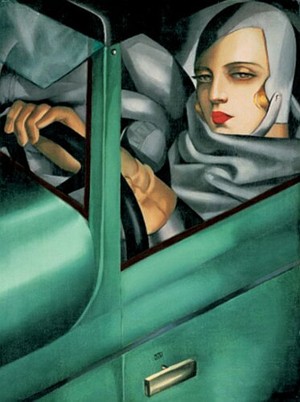
For many designers, the bold bright colors and geometric designs of Art Deco (“Arts Decoratifs”), which reached its peak in the Roaring 20s, represent the best and purest forms of that art period. Of all the artists who pursued the Art Deco style, the most memorable may be Tamara De Lempicka. Born in 1895 in Moscow (she preferred to say she was born in Warsaw, Poland, in 1902) to a wealthy and prominent family, she has been called the “first woman artist to be a glamour star.” She was also a world-class liar, a termagant, a vainglorious socialite, and possibly one of the 20th century’s most important artists.
Tamara’s wealthy grandmother spoiled the beautiful young girl with travel and clothing. When she was 14 her grandmother sent her to boarding school in Lausanne, Switzerland, and after her parents’ divorce she spent time in St. Petersburg, Russia, with her Aunt Stephanie, whose husband was a millionaire. After enjoying the high life with her relatives, Tamara decided this was the life for her, and immediately set out to get it.
At age 15, while attending the opera, she saw a man she became determined to marry. This was Tadeusz Lempicki, a lawyer by title but also a well-known ladies man and society gadabout. They were married in St. Petersburg in 1916 with Tamara’s banker uncle providing a handsome dowry. Lempicki, who had no money of his own, was delighted to marry a beautiful 16-year-old girl with plenty of money included.
A year later during the Russian revolution, Tadeusz arrested by Bolsheviks in the dead of night. Maria bravely searched the prisons for him, using her charm and good looks to get favors from the necessary officials. After several weeks, with the help of the Swedish consul, she found Tadeusz and got him out of the country. They fled to Paris, France, where Tamara’s family had escaped and relocated.
The couple lived in Paris on money from the sale of family jewels. Tamara, now known as “Tamara De Lempicka” studied art and worked day and night. Her bold and distinctive painting style, somewhat influenced by cubism, was perfectly suited to the exotic, sexy and glamorous tastes of 1920s Paris. Her technique was novel, clean, precise and elegant. As for Tadeusz, he either couldn’t or wouldn’t find work. During this period Tamara gave birth to a daughter, Kizette.
For her first major show in Milan, Italy, in 1925, De Lempicka painted 28 works of art in six months. She quickly became most fashionable society portrait painter of her generation. Her daughter, Kizette De Lempica-Foxhall, wrote in “Passion by Design,” a biography of her mother, that “She painted them all; the rich, the successful, the renowned — the best. And with many she also slept.” The work brought De Lempicka critical acclaim, social celebrity, and great wealth. A portrait usually took her about three weeks, and by 1927 she could charge $50,000 francs (about $20,000 in today’s money).
In 1925 she painted one of her most famous works, “Auto-Portrait (Tamara in the Green Bugatti)” for the cover of “Die Dame,” a German fashion magazine. According to the magazine “Auto-Journal, “the self-portrait of Tamara De Lempicka is a real image of the independent woman who asserts herself. Her hands are gloved, she is helmeted, and inaccessible; a cold and disturbing beauty through which pierces a formidable being — this woman is free!” One might also add that those hooded eyes have a rapacity that seems to sum up the real woman, who couldn’t get enough cash, fame, or sex.
De Lempicka enjoyed the bohemian life of Paris in the Roaring Twenties. She hung out with Picasso, Jean Cocteau, and the other famous artists and poets who gathered together regularly. She also was the subject of numerous scandals for her affairs with both men and women. Her marriage became simply an “arrangement” and in 1927 her husband abandoned her. They were divorced in 1928.
Obsessed with work and social life, De Lempicka neglected more than her husband. She rarely saw her daughter, who lived with her grandmother when she wasn’t at boarding school in France or England. Despite her mother’s domination, occasionally Kizette showed a flash of spirit. In 1929, when Kizette learned that her mother would not be coming back from America for Christmas, she took De Lempicka’s enormous collection of designer hats out of their closet and burned them, one by one, with great relish.
Strangely, although De Lempicka neglected Kizette, she painted pictures of her repeatedly, leaving a striking series of portraits that chronicled her daughter’s growing up: “Kizette in Pink,” “Kizette on the Balcony,” “Kizette Sleeping,” “Portrait of Baroness Kizette,” etc. In many of De Lempicka’s other paintings, the women depicted bear a resemblance to Kizette.
In 1928 her longtime patron Baron Raoul Kuffner commissioned her to paint his mistress. De Lempicka painted the portrait — then took the mistress’ place in the Baron’s life.
(To be continued)
POSTED: 06/15/11 at 7:22 pm. FILED UNDER: What's Up at Wassenberg?