







Art, Music, Learning, Fun – Go!
By Hope Wallace
The really cool thing about running an Art Center in addition to having fun in the moment, is that there is always something to look forward to! Last week we talked about the new programs and classes we are implementing and they continue to expand. Since our last article, we’ve finalized plans for another class! “Come Over to the Right Side” helps people exercise the ability to access the right side of their brain where visualization and creative expression hail from. I cannot wait to take it. Often while learning to utilize this side of the brain for drawing, the results can often be dramatic. “Come Over to the Right Side” will be a 4-part class occurring on Mondays, July 1, 8, 15, and 22, from 6:30 to 8:30 p.m., taught by our own Pat Rayman.
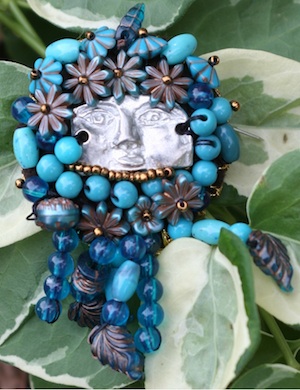
Our morph-work illustrated initial class for kids is coming up this Saturday. “Wild Women” pins follows quickly on its heels and will be held on Tuesday, July 19. Contact the Wassenberg Art Center for more information on this adult class. There are still some spaces left so get in your registration soon!
Music, art and food simply go together. We will be looking forward to more musicians, live music and great food at upcoming exhibit receptions, stay tuned.
We are also planning the 2012 exhibit season and the old cliche “child in a candy shop” certainly applies here. In addition to our traditional exhibits and shows, we’ll be seeing many new faces and presentations.
So, drum roll please and stay tuned! An organization that has brought you a venue for exploring the arts for over 50 years sits on a main street right in your hometown. Consider becoming a member. Your support creates a cohesive organization that can continue to grow and deliver a component of what strong communities require, an outlet for preserving their culture, an arts center. Memberships are available at several dues levels — an individual membership will pay for itself in discounts it offers in approximately two classes.
Call the Wassenberg Art Center at 419.238.6837 or e-mail wassenberg@embarqmail.com to register for classes or join us! The art center is located at 643 S. Washington Street, Van Wert.
Caravaggio — Bad Boy of Renaissance Art
By Kay Sluterbeck
He lived not quite 37 years, but in that short span he was a rebel in both life and art, with a reputation for disorderly behavior unmatched by any other major painter. From his birth — September 28, 1573 — he was in trouble almost constantly, first as an unruly child and then as an adult. After accumulating a long string of problems with the law, he had to leave Rome to escape imprisonment for murder.
We know few hard facts about him. He was baptized Michelangelo Merisi (ironically, he was named after the archangel Michael), but he is known by the name of his birthplace — the small town of Caravaggio in Italy. He was the son of a mason, but he apparently showed enough precocious talent that he was apprenticed to a painter, Simone Peterzano, at the age of 10.
Simone was a mediocre artist but a good teacher. During the next four years young Caravaggio received solid practical how-to-paint training. By the time his apprenticeship ended, he was already fighting against the artificial-looking painting styles popular at the time, and was formulating his own idea of what art should be — “a good artist means a man who knows how to paint well and to imitate natural things well.” Caravaggio headed for Rome in search of artistic freedom.
He struggled for several years, doing poorly paid hack work for others, sometimes trading paintings for lodging and meals. After a while this hand-to-mouth exicstence took its toll and Caravaggio became seriously ill, possibly with the plague that swept Rome in 1591. A religious order took him in as a charity patient. When he recovered he again struggled along doing portrais and still lifes. Before long he was destitute again, his clothing almost in rags. Generous fellow artists saved him from starvation, and when at last a picture dealer agreed to take on some of his unsold paintings Caravaggio’s luck began to turn. He was discovered by Cardinal Francesco del Monte, who bought some of his paintings, commissioned more, and gave him a home. This led to more important patrons, and within a few years the penniless artist was being called “celeberrimus pictor” (renowned painter).
Caravaggio specialized in religious paintings, where he interpreted spiritual subjects in rational, earthly terms. His figures were based on live models. By using deep shadows and strong light sources along with expressive gestures, he created a mysterious unearthly quality. His pictures were all about emotional impact — the climactic moment in an event: the astonishment of the disciple Thomas when the risen Christ reveals the wound in his side; the spectators recoiling with horror as the executioner’s sword swings toward St. Matthew’s neck. He invited the viewer to take part in the scene; for example, in the “Supper at Emmaus” (circa 1600) Christ extends a hand toward the viewer. Works like this contributed to his fame.
However, as his fame increased so did his reputation as a troublemaker and public nuisance. He would work at his easel for a couple of weeks, and then for a month or so he headed to the sordid part of Rome to party or swagger through the streets spoiling for a fight. If a fight didn’t materialize, he soon managed to start a brawl with his friends, or sometimes with complete strangers.
The first mention of him in the police records was November 19, 1600, when he was 27. Apparently he attacked a man at night, apparently without cause. “The defendant came up with a stick and began to beat me,” claimed the victim. From that time Caravaggio appeared in the police blotters every few months for compaints ranging from serious to ridiculous. He pelted his former landlady’s window with stones after she sued him for unpaid rent. He threw a plate of artichokes at a waiter and then threatened him at sword point. He assaulted a notary over the affections of a prostitute. He was jailed for carrying a sword and dagger without a license. Once, when he was actually able to produce a permit, he insulted the police corporal who had asked to see it, saying “you and all those who are with you can shove it.” His friends were constantly bailing him out of jail.
One day, after a match of palla a corda (a game like tennis), an argument broke out between the artist and a member of the opposing team. Tempers flared, swords were drawn, and Caravaggio ended up seriously wounded — but the other man was dead. When the authorities went to the house where he was recovering to question the artist, he claimed he knew nothing. “I wounded myself with my sword in falling on these streets; I don’t know where it hapened and no one was present.” The police told him not to leave the house — but a day or two later he had vanished from Rome.
(To be continued)
POSTED: 07/13/11 at 12:19 pm. FILED UNDER: What's Up at Wassenberg?