







LineArt Initial!
By Hope Wallace
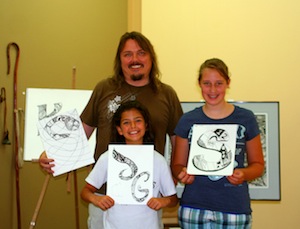
Our LineArt Initials class was held Saturday, July 16, and I think we had a great time! Instructor Scott Kraemer of Bryan started the class by offering several suggestions for fonts to choose from. He noted that any letter would work, not just an initial for a name, so one class member chose a letter to honor her well-loved cat.
Start out with a simple doodle; think about what you like and are all about, and simply draw. It doesn’t have to be “good”, because things you aren’t satisfied with can be drawn over or turned into something else. Do you like water, candy, horses, or flowers? Go for it. Though I was a teensy bit over the age limit, I asked if I could join in and quickly became addicted (the candy helped too). I was compelled to finish my “H” after class.
Watch for LineArt Initial classes to be offered to adults in the near future. We’ve had several interested parties and will be offering the class to “grown-up kids”. (Don’t forget the candy!)
If you would be interested in joining a unique class to expand your creative forces, stop in, give us a call or check our website for current listings. We are adding “Medieval Multimedia,” a multimedia painting class, in August. Details soon!
You can reach us at: Wassenberg Art Center, 419.238.6837, or e-mail wassenberg@embarqmail.com to register for classes or join us!
The art center is located at 643 S. Washington Street, Van Wert.
Caravaggio (Continued)
By Kay Sluterbeck
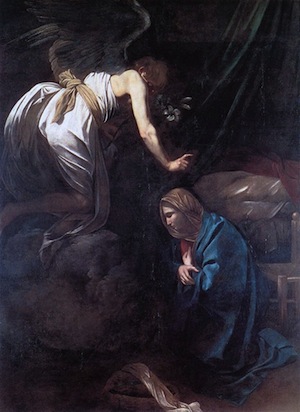
“The Annunciation,” oil on canvas, by Caravaggio.
After numerous run-ins with the law, the artist Caravaggio fled Rome to avoid a murder rap. He went to the Sabine Mountains, east of the city, where he was out of reach of the papal courts but close enough to keep in touch with influential friends. He hoped they could help him get a pardon from the Pope on the grounds that the killing wasn’t premeditated and he himself had been wounded by his opponent.
However, no pardon was forthcoming. Around 1606, almost out of money, he moved south to Naples in hopes of making a living as a painter. It was a good choice. Naples had not had an outstandingly talented painter for man years, and Caravaggio quickly obtained plenty of high-paying commissions that kept him busy (and out of trouble) until 1607, when he decided to sail for Malta.
Soon after he arrived in Malta, he met the Grand Maser of the Order of St. John and painted two portraits of him. The Grand Master was delighted with them, and shortly after that Caravaggio was received into the order with the title Knight of Obedience.
For several months things went smoothly and he was showered with commissions for various churches.. One of them was an enormous canvas measuring about 12 x 17 feet showing the beheading of St. John the Baptist. It so impressed the Grand Master of the Order of St. John that he gave Caravaggio “a rich collar of gold…and two Turkish slaves, with other marks of esteem…”
Caravaggio enjoyed the high life for a while – until the dark side of his nature got the better of him once again. In 1608, no one knows why, he quarreled with a fellow knight of highest rank – a serious offense — and was thrown into prison. Not waiting to hear what his punishment would be, he climbed the prison wall at night and hopped a boat to Sicily. The Order of St. John voted unanimously that the artist be “deprived of his habit, and expelled and thrust forth like a rotten and fetid limb from our Order and Community.”
In Sicily Caravaggio kept moving, apparently fearful of retribution by the knights of St. John. His fame as an artist preceded him as he traveled from city to city, so he had plenty of commissions; he would paint for a while and then move on.
Finally Caravaggio heard that his friends in Rome were negotiating with the Vatican to obtain a pardon for him, so he embarked for Naples. Still trying to appease the Grand Master in Malta, Caravaggio painted and sent him “Salome with the Head of St. John,” which is the artist’s last known surviving work. But the Grand Master wasn’t placated, and it was probably his cutthroats who cornered the artist one night in the doorway of an inn. When they finished with him he was so gashed around the face that he was hardly recognizable, and a rumor spread that he had been murdered.
Caravaggio recovered from that near-fatal attack, but his luck was running out. In June 1610 he put everything he owned on a ship bound for Port ‘Ercole (a coastal town in Tuscany). He had heard that his pardon was imminent and probably wanted to be as close to Rome as possible. However, he didn’t want to actually set foot in papal territory in case the Pope might suddenly change his mind.
In Port ‘Ercole Carravaggio was arrested again – but this time it was for a crime he had not committed. He was seized and held in jail until his identity was established a few days later. While he raged in jail the ship sailed again, apparently with all his belongings still on board.
Almost crazed with fury and desperation, Caravaggio tried to catch up with the ship by slogging along the swampy, malaria-ridden shore in the merciless summer sun. Not far from Port ‘Ercole he collapsed with fever and exhaustion. On or about July 18, 1610, two months short of his 37th birthday, he died. A few days later the Pope confirmed his pardon. And it was discovered that his belongings had never left Port ‘Ercole but remained in the safekeeping of local officials.
When his death was announced in Rome, his friends and contemporaries mourned the loss of a great artist. The poet Giambattista Marino wrote, “Death and Nature…made a cruel plot against you: Nature feared being surpassed by your hand in every image that you created …Death burned with indignation because your brush returned to life, with large interest, as many men as his scythe could cut down.”
POSTED: 07/20/11 at 12:56 pm. FILED UNDER: What's Up at Wassenberg?