







Court project judges’ dream come true
CINDY WOOD/independent feature writer
It’s been a long time coming.
For the better part of 150 years, Van Wert County residents have conducted their business at the architectural gem known as the Van Wert County Courthouse. The building has stood prominently in the center of downtown Van Wert since 1876, a testament to the heritage and history of those who came before us.
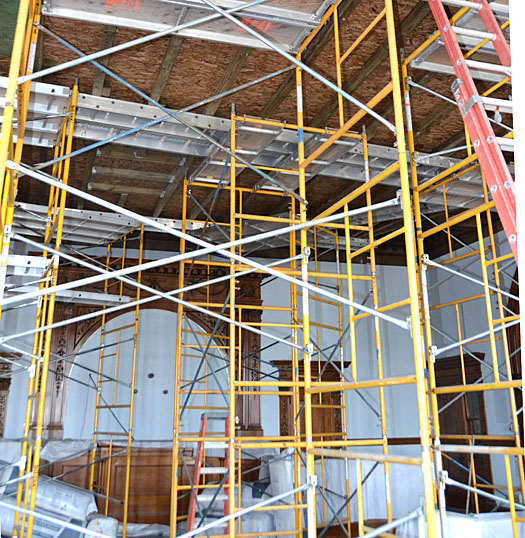
Over the course of the past year, the courthouse has undergone a much-needed renovation that brought back to life much of the building’s original shine and design. While everyone can certainly appreciate the upgrades, an upcoming open house will hold special meaning for two men, Judges Sumner E. Walters and Charles Steele.
Judge Walters, who presided over the Van Wert County Court of Common Pleas from 1983 to 1999, and Judge Steele, the current Common Pleas judge, are both staunch believers in the preservation of the county courthouse.
“I think the people of Van Wert County need and deserve a ‘temple of justice’; an edifice to which they can point with pride, safe in the knowledge that their problems and grievances can and will be dealt with fairly and equitably,” Judge Walters said, adding, “a modern office building, popular in some counties, containing utilitarian courtrooms simply fails in this essential purpose. The people were ‘given’ this courthouse by prior generations of citizens who understood this purpose. I believe it is the duty of succeeding generations to preserve and protect this very special place.’”
During the 1950s, the stunning stained-glass dome, which had deteriorated and was badly in need of repair, was covered with an acoustical drop ceiling in the Common Pleas Courtroom. The dome remained covered for the next six decades until this year, when it was uncovered, repaired and restored to its original brilliance.
Judge Steele can only shake his head at the thought of covering the dome. “When you see it now, it just strikes you how anyone could have ever covered that up,” he said. “And then you think about someone knocking holes in it to run venting and it honestly just amazes me. I just don’t understand why they didn’t fix it then, instead of covering it up. They could have done it for a lot less money then.”
Judge Walters originally got the ball rolling two decades ago, but tough economic times and a lack of funding kept the project from moving forward.
“Disturbed by the false ceiling in the courtroom and the mess that had been made of the old dome, I set about to see if we could restore the courtroom to its former grandeur,” the former local judge said, adding that several government officials were also involved in the brainstorming process.
Although the county commissioners at the time offered their moral support, they could not offer any financial backing to offset the $400,000 it would take to see the project through. Essentially, the project was at a standstill.
“The only way we could get over the financial hurdle was to find grant money,” Judge Walters said, “but we were unsuccessful in finding sufficient financial backing to move the project forward.”
The Ohio General Assembly breathed a breath of fresh air into the project in 2001 when it passed Ohio Revised Code Section 2903.201, a new state law that allowed courts the ability to use court costs as a stream of revenue to fund special projects. In its simplest form, it was a court piggy bank.
In accordance with the new state law, Judge Steele, intent on carrying out the initial work of Judge Walters, established the Special Projects Fund of the Van Wert County Common Pleas Court in 2005. Over the years, proceeds from this fund have paid for travel and education of court staff, as well as establishing a mediation program for both civil and domestic relations cases. The fund has also paid for equipment and furniture.
“Without this fund, the money for all of these expenses would have come from the county general fund,” Judge Steele said, adding that approximately $365,000 of the fund was set aside to be used for the ceiling restoration project. “We started a kitty and started putting all of the court costs that have been collected over the years into this fund. It’s amazing to think that these recent renovation projects to the courthouse have been paid for out of this fund. None of that was taxpayer money.”
Once the project started picking up steam, the commissioners utilized Senate Bill 300 to pay for the installation of updated, energy-efficient HVAC systems in the courthouse. “To get this, you have to complete an energy audit, and our audit said we would see a savings of about $43,000 a year,” Judge Steele said, adding that, up until six months ago, many elements of the heating system were installed when the building was built in 1876. “So that savings is what you use to pay back the money you used to purchase the system.
“The system had nearly collapsed and we just had major problems with radiators leaking, and the system was just too old to try to repair,” Judge Steele said. “I’m so grateful to the commissioners for their assistance in everything; we truly couldn’t have accomplished all this without them.”
The renovations to the courthouse are now complete, bringing an end to a years-long process that began, simply enough, with a small committee of citizens interested in the preservation of the county’s courthouse.
Judge Steele hopes this weekend’s open house will encourage people to see the courthouse for what it is — a stunning piece of county history that deserves attention and respect.
“I want people to just stop for a second out of their day and just stand in front of our courthouse,” he said. “Just stop and admire the architecture, which is truly amazing — especially considering that people could actually build something of this magnitude back in those days. It truly is awesome, if you take the time to think about it.”
POSTED: 12/03/12 at 7:35 am. FILED UNDER: News