







VWHS now New Tech demonstration site
DAVE MOSIER/independent editor
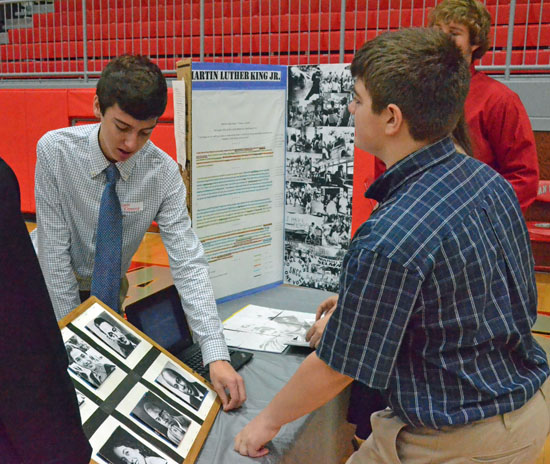
After a challenging year of implementing the New Tech High School teaching model at Van Wert High School, both VWHS Principal Bill Clifton and Superintendent Ken Amstutz are pleased with the program’s progress. So is the New Tech Network, which recently announced that VWHS would be a demonstration site, starting in the 2013-2014 school year.
“That means to us we’re doing things the right way,” Amstutz said of the designation. “Our staff has bought into it.”
The designation, while important recognition for the district’s New Tech program, also means more responsibilities down the road for VWHS staff members. “We’re going to have to prepare for schools to come in,” said Clifton. “We have to have a well-oiled presentation ready to go on New Tech.”
That doesn’t mean it hasn’t been a challenge to implement the program, now heading into its second year at VWHS. During its initial year, school officials heard from both students and their parents who were concerned about the changeover to the New Tech program.
Mostly, Amstutz said, the concerns centered on grades. “It’s not about learning, it’s about my ‘A’,” the superintendent said, noting that grades shouldn’t be as important as the educational value derived from an educational program. “It’s about learning, it’s about knowledge, it’s not about whether you have a 4.0 average and another student has a 2.0 average.”
Some feared that New Tech, a project-based learning program, would mean students’ grades would suffer because they would be graded on what others were doing.
Those fears didn’t pan out, the superintendent said, mostly because there is also a significant amount of traditional education included in the program, but also because students’ grades are mostly related to their individual work and test scores.
Both Amstutz and Clifton said they feel that, not only is New Tech the best way to prepare students for college and the workplace, but it has also been a positive for teachers as well, although Clifton did note that the program does require teachers to do much more planning than they would in a more traditional educational program.
Before the New Tech program, teachers basically stayed in their own classrooms and didn’t share what they were doing with other teachers. Now, math teachers know what science teachers are doing, as well as what is happening in the English department.
The key benefit, he stressed, is the amount of collaborating being done by teachers and the synergy created by that collaboration.
“It’s not one brain working, it’s multiple heads coming together to do what is in the best interest of the kids,” the VWHS principal added.
Also unheard of in the past is the fact that teachers are coming together on their own time after school to hold training sessions on technology and other topics to ensure they keep up on what is needed to provide support for their students.
Moreover, unlike a more traditional educational program, New Tech shifts more of the burden of education to students themselves, with teachers acting as facilitators for project-based learning, rather than spending most of their time lecturing to students. Now, groups of students must work together and take responsibility for coming up with ways to complete a project.
It’s a concept that some students have resisted, Clifton said, basically because they now think teachers
“aren’t doing anything,” but the VWHS principal said that’s because they don’t see all the work teachers put in outside the classroom on planning and training.
But Amstutz said project-based learning, in his mind, is the proper approach to educating students. “If you read anything about project-based learning and what we are doing, it’s really the right thing you should be doing in education,” the superintendent said of the project-based and problem-based New Tech system. “That’s the way that kids learn, that’s the way they should be learning.”
One positive already being seen from the program is the improvement in students’ presentation skills. “Our seniors last year said the freshmen presented better than they did,” Clifton said.
Meanwhile, although VWHS now has a year of the program under its belt, that doesn’t mean there won’t be additional challenges this coming year as New Tech is expanded to a second class en route to eventually having the entire high school being taught under the program.
That means another set of teachers who had to be trained on how to implement the program, as well as another freshmen class who will have to learn to work together.
Even with all the work involved, Amstutz said the school district’s commitment to New Tech won’t stop at the high school, with plans now in the works to implement some level of project-based learning in grades 4-8 in the next couple of years.
“It’s a natural extension,” the superintendent said, noting that having younger students involved in project-based education will make the transition to the high school’s New Tech program much more seamless.
POSTED: 08/01/13 at 6:30 am. FILED UNDER: News