







More forgotten Paulding County RR towns
Editor’s note: This is one of a series of articles in conjunction with Paulding County’s bicentennial celebration.
KIM SUTTON/for the Van Wert independent
PAULDING – All aboard, as we continue with the history of Paulding County railroads and their forgotten towns.
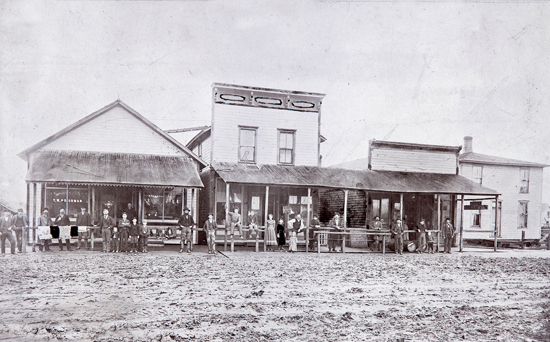
The second railroad to cross Paulding County ran north and south through Cecil, Paulding Furnace, Holcombeville, Paulding, Latty, Dague, Folmer, Haviland, and Scott. Four of these settlements along the railroad no longer exist. They are the forgotten towns and will be the focus of this article.
When fully completed, the line ran from Cincinnati through Van Wert and on to Mackinaw, Michigan. It carried numerous names throughout the years, but was more popularly known as the Cincinnati Northern. Today, the only part of the track that remains runs beside Lafarge and into Cecil connecting onto what was once the Wabash Railroad.
This major north-south line had a very humble beginning, starting out as a short track made of strap iron built by the owners of Paulding Furnace that ran from Cecil, past the Paulding Furnace, and southward for two miles. Paulding Furnace was located on the north side of the Wabash Erie Canal. Today, we would locate it on County Road 180 (Canal Road) at County Road 105. The track was used by the company to haul wood from the forests to the kilns.
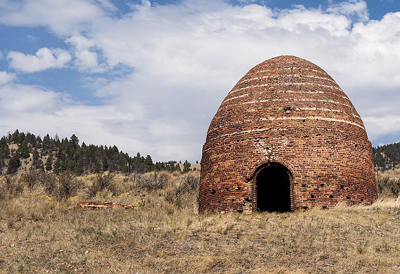
Paulding Furnace was established in 1864-65 by Evans, Rodgers & Co. because of the abundance of old growth forests and access to the Wabash Railroad and Wabash & Erie Canal. Iron ore was brought in from the Lake Superior ore deposits, first traveling by lake to Toledo, then to Paulding Furnace by the canal or railroad. The ore was smelted using burning charcoal, which was made in numerous beehive kilns.
The furnace unquestionably aided in the settlement of Paulding County. The company purchased vast amounts of land, cleared off the timber, and then leased the cleared land to farmers. Paulding Furnace employed about 250 men, who cleared thousands of acres of woodland.
Although Paulding Furnace was not incorporated, nor did it have a post office (mail was received at Cecil), the early newspaper archives tell of its “neighborhood news.” Church services were held there, and there was a blacksmith shop and a store. People are referenced as living at Paulding Furnace and in the Paulding Gazette of May 12, 1887, it was announced that Miss Mary Schaffer would be teaching school at Paulding Furnace.
Henry Howe gave us the best description of what Paulding Furnace looked like in his book, Howe’s Historical Collections of Ohio. He wrote that, about a mile and a half south of Cecil, stood a huge brown building with a 40-foot smokestack and, beside it, 23 structures shaped like beehives about 15 feet high. The structures, white as snow, made of brick, and plastered with lime, were kilns used to burn wood needed to make charcoal that was used for smelting ore shipped in from Lake Superior.
In 1877, George W. Potter, prominent businessman and banker, understanding the importance of having a railroad run to Paulding, purchased a narrow-gauge railroad that had been in operation in Columbus but was taken up because the line had been condemned. The material was brought to Paulding and work commenced on constructing a railroad from Cecil to Paulding. However, there was only enough rail to reach Possum Run, about a half mile from Paulding. From there on, it was made of wooden planks and horses were used to pull the cars into Paulding.
In 1879, John Evans, superintendent of Paulding Furnace, with the aid of citizens from Paulding and Cecil, constructed a standard-gauge railroad connecting Paulding to the Wabash Railroad. The first train ran on it into Paulding on September 1, 1880.
In 1881, the rail line passed into the hands of the Paulding and Cecil Railway Company, S. Frank Eagle president, and was operated by that company until 1884, when it was sold to the Cincinnati, Van Wert, and Michigan Railway Company.
In 1887, Eagle leased Paulding Furnace and it became known as Bertha Furnace. It is interesting to note that, on May 19, 1887, about a month after the Reservoir War — the dynamiting of the abandoned reservoir and locks along the Wabash & Erie Canal — Ohio Governor Foraker visited Antwerp. After the governor made a personal inspection of the reservoir and spoke to local citizens, he boarded the train in Antwerp on his way to Toledo. Upon arrival in Cecil, he was met by a carriage and taken to Paulding Furnace, where the distinguished governor and his party remained overnight with Eagle.
A dark cloud of misfortune seemed to settle upon Bertha Furnace in the summer of 1887. On August 5, an employee was severely burned by escaping gas caused by what is known as a “jump” of the furnace. On September 22, the bell (an operational component) fell into the furnace and necessitated a shutdown of several days. On September 29, the inner wall of the stack fell in and caused serious burns to the face and head of the foreman. The week of October 13, an accidental explosion of gas severely injured a workman’s head.
In addition to these misfortunes, the Wabash & Erie Canal was never the same after the dynamiting, and Bertha Furnace had trouble receiving or sending shipments by canal. As a result, by October it was announced that Bertha Furnace was shutting down operations, ending the existence of the little settlement.
However, the establishment of the connection from Paulding to the Wabash Railroad opened up new business opportunities and growth. One such business was started by Major A.B. Holcombe and was called the Holcombe Stave Factory, which grew into a small community known as Holcombeville.
The Antwerp Argus dated March 8, 1888, had this to say about the factory: “Major Holcombe, at his hoop and stave factory north of Paulding, is just rushing things, and making the sawdust fly, both day and night. He has in his yard nearly three million feet of elm logs, and has made contracts with foreign parties for the sale of 300,000,000 staves.”
Holcombeville, sometimes called Holcombe, was a known settlement located on CR 144 (Gasser Road) at the intersection of Road 103. It was spoken of in the Paulding newspapers as early as 1887. Today, it is at the approximate location of Schweller Electric Co. The town had a large general store, a blacksmith shop, a boarding house for workers, several residences, and a ball club. Church services were held by two different ministers at different times in the school house. Known teachers at the school were T.J. Spriggs and James A. McBride.
By March 1891, a community had grown enough to warrant a post office. The Paulding Democrat informs us: “A post office has been created at Holcombe, a mile northwest of this place, with Major Holcombe as postmaster and Earle Travis, the storekeeper, as deputy. The new office is called Morrison, in honor of U.S. Chief Justice Morrison R. Waite, a member of the firm of A.B. Holcombe & Co. The Cincinnati, Jackson and Mackinaw will also put in a telegraph office and make a regular station of the place. Hurray for Morrison.”
The stave mill closed down June, 10, 1893. The Paulding Democrat published on June 22, 1893, tells us: “Holcombeville, until recently a very busy mill town, is as quiet as quiet can be. The sawmill and bolt cutters are through and, as soon as the stave joiners finish their work and the stock is shipped, Farmer Holcombe will be able to add several acres more to his 80-acre corn patch. The operatives are leaving and soon all but help about the yards and farm hands will have accepted places elsewhere. The quiet prevailing at Ho’cum is oppressive.”
The Morrison Post Office was ordered closed in 1894; the residents would be receiving their mail in Paulding. The little town was done, but the stave mill was converted into a tile mill and continued operation until the death of Major A.B. Holcombe in 1898.
Another little town to pop up along the Cincinnati Northern was named Dague. When the railroad was put in, it went through H.C. Dague’s farm. Hamilton Chauncy Dague laid out 38 lots in the original plat of Dague in the early 1880s. The town was located about five miles south of Paulding on Road 72 and along the east side of the railroad tracks.
As the railroad became popular, the post office was moved to Dague in 1882 from Pleasant Point, another forgotten community, a half-mile east. A stone building was also moved from Pleasant Point to Dague to be used as a school house and church. Dague soon built a new school house and the stone building was taken over by the United Brethren Church.
At one time Dague was a thriving community with a train depot, two general stores, a hotel, barber shop, church, school (1888 school census shows there were 130 children in attendance), doctor’s office, blacksmith shop, saloon, and more than a few homes. There was also a shop that made hickory chairs, while the bowl factory of Capt. C. Neff stood beside the chair shop. It was three stories high and turned out 40 dozen bowls per day, made out of cottonwood. Dague even had a skating rink!
As the timber ran out, Dague started to dwindle. The post office closed March 15, 1905, and mail was rerouted through Latty. The old railroad bridge over Blue Creek is still visible south of Road 72, about half a mile across the field.
The next little town we are going to visit was about two miles south of Dague and laid out on Road 48, between U.S. 127 and MacDonald Pike, along the Cincinnati Northern Railroad. The town was called Folmer, which has been spelled many different ways throughout the years. The small community was founded by Andrew Follmer, a German immigrant. The railroad went through Follmer’s farm, so Mr. Follmer started a town and called it Folmer.
Folmer had a church, train station, a hotel, grocery store, and a school. The post office of Folmer opened on March 8, 1882. The known postmasters were S.G. Bowyer and Levi A. Fast. The Paulding Democrat reported the news of Folmer under a column titled “Folmer Facts.” From this column we learn that Folmer had a pretty good ball team, church suppers and entertainment, and school events.
The post office closed December 31, 1896, and residents then received their mail through the Haviland post office. Folmer later went the way of the other railroad towns. The last mention of Folmer in the newspapers was reports from the Folmer Bethel Church in 1917.
More information on the bicentennial can be found on Facebook at www.facebook.com/PauldingCounty200.
Next time: Part 3 of Railroads and Their Forgotten Towns.
POSTED: 05/13/20 at 10:34 pm. FILED UNDER: News