







New sports betting restrictions proposed
By Nick Evans/Ohio Capital Journal
COLUMBUS — Three Ohio Republican lawmakers are introducing legislation to place “guardrails” on the state’s sports betting system, including stopping online/phone gambling, limits on wagers, banning the use of credit for betting, and limiting advertisement.
They warn that gambling is as addictive as illegal drugs, costs Ohio citizens enormous amounts of money, and threatens the integrity of sporting events.
Clinical Director of Addiction Services at Lindner Center of Hope Dr. Chris Tuell explained among addictive behaviors, gambling has the highest suicide rate.
He added that the number one reason for divorce isn’t infidelity, it’s financial problems.
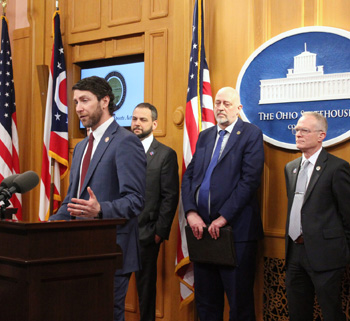
“This is Narcan,” he said, holding up the small plastic nasal spray. “We don’t have a spray for problem gambling. We don’t have a pill for problem gambling.”
Ohio state Reps. Riordan McClain, R-Upper Sandusky, Gary Click, R-Vickery, and Johnathan Newman, R-Troy, acknowledge that sports betting is here to stay. But they want to place restrictions on what, how, and where Ohioans can wager.
“The fact is that most betters do not win,” McClain said, citing statistics that only about five percent of sports bettors make money over the long term.
“That means roughly 95 percent of Ohioans who are betting make deposits, not withdrawals,” McClain said.
Click asked, “Is it really worth the taxes that we gain to risk people’s lives, their mental health, their personal well-being, their families, their homes? I don’t think it is.”
“So, while we’re not going to roll back the clock to what it was before,” he went on, “we’re going to put some common-sense consumer protections in place to protect Ohio citizens.”
The legislative language for the lawmakers’ ideas is still getting hammered out, but they’re expecting to file two proposals: one focused on consumer protections and the other on sports integrity.
Consumer protections
Newman described Ohio’s current sports betting landscape as a freeway with “no lines on it, no speed limits on it, no off ramps.”
“What we’re trying to do is provide some lines on the freeway, some guardrails, some off ramps, and some speed limits to rein in some great harms that we see,” he said.
The consumer protection measure will place restrictions on how much Ohioans can wager and how often they can do so in a day.
It will also bar bettors from using credit cards or other forms of debt to place wagers.
Sports books would face new limits on where and when they can run ads, and they would not be allowed to offer financial incentives to get people involved.
“The comparisons to drugs here are so unbelievably obvious,” Center for Christian Virtue President Aaron Baer said. “Where they’re like, hey, just come get a taste, right? And then, you’ll see you like it, and then you’ll come back for more and more.”
Perhaps most significantly, though, the lawmakers want to limit betting to Ohio’s casinos — effectively prohibiting Ohioans from placing bets on their phones.
“When you combine the addiction of gambling with the addiction one of these devices,” Click said, holding up a cellphone, “it’s synergistic in a bad way. It multiplies upon itself.”
Tony Coder, CEO of the Ohio Suicide Prevention Foundation, explained suicide often happens when an individual is alone.
“Therefore, language that restricts sports betting only within casinos, rather than on a phone while sitting alone at night could prevent that,” Coder said.
“Those are lonely moments, and they can intensify as one dwells on their own thoughts and there is no one there to help that person find help.”
Sports integrity
McClain, Click, and Newman are also concerned about impact sports betting could have on the games themselves.
“Think of how much outrage we feel when a ref misses an obvious call,” Newman said.
“We feel the outrage. Do we really want the rest of our lives to be watching every bad call from a ref going, who’s in his ear? Who’s calling him? Who’s threatening his family? Do we want that?”
The sports integrity bill will prohibit any in-game bets as well as any wagers on college sports.
It does away with what are known as ‘prop’ bets, too.
Those are wagers based on a particular player’s statistics in a given game — for instance, touchdowns scored, strikeouts thrown, or three pointers made.
In an executive order, Gov. DeWine already prohibited prop bets for collegiate sports but stopped short of doing the same for professional contests.
The measure will also eliminate parlay bets, where a bettor string together several different wagers into one.
Those bets offer higher returns, but the odds are stacked heavily against bettors.
Road ahead
For all the sponsors’ legitimate concerns about financial losses and mental health impacts tied to gambling, however, they’re likely to face an uphill climb.
Legislation that made sports betting legal in the state passed overwhelmingly in 2021.
Click noted there are many lawmakers who have misgivings about gambling. He pointed to the failed effort last year to legalize online casinos as part of the state budget.
McClain acknowledged that in his conversations with colleagues, “the initial response certainly is mixed, but there is support for this.”
He added that while the governor hasn’t endorsed their legislation, there are elements in the proposals that he’s supported in the past.
POSTED: 04/09/26 at 6:40 am. FILED UNDER: News