







Lost, but not forgotten — ever again
Editor’s note: this story with ties to Van Wert orginally appeared April 23 in The Daily Record, a newspaper in Dunn, North Carolina. It is being republished by the VW independent with permission from The Daily Record.
By Emily Weaver/managing editor, The Daily Record
Janene Young Goins and her family searched for the remains of her sister for 64 years before Goins found them in an unmarked field, on an unplanned visit in act of “divine intervention.”
This story “has a horrible beginning, but … a very happy ending,” Goins wrote in a recollection of the unexpected events that unfolded in September 2025.
Goins and her husband were on their way back home to Willow Spring, North Carolina, on a cross-country trip in their RV to Wyoming and South Dakota when they stopped in Van Wert, Ohio, for Goin’s 50th class reunion.

“Leaving there, we had to go by Columbus, Ohio, to get back to North Carolina,” she said. “On a whim, we decided to stop by the last known place where we believed Judy’s remains were located, the Pickaway Correctional Institution in Orient, Ohio. …”
Judith Anne Young
Goins’ older sister, Judith Anne Young, was born on Jan. 24, 1950, in Van Wert, Ohio. The delivery wasn’t going well so doctors were forced to use forceps to pull Judith out by her head. Baby Judith suffered brain damage as a result.
“She needed full-time special care and (there were) not many options (for that) in the ’50s,” Goins said. “My mother was British and my parents, brother, myself and my sister, Cheryl, had to go to England due to her father’s failing health. My sister could not travel like that so she was placed in care at the Orient Feeble Minded Institute in Orient, Ohio. I believe she was 7 years old when she went in.”
Goins said her mother had no idea that asking the institute to care for her daughter while they were away meant that she was signing over her rights to Judith, but that’s what happened. Judith became a ward of the state.
My family tried to see her on different occasions, but they were never allowed, Goins said.
While Goins family was away, during another trip to England, Judith died. She was 11 years old. Her family received a letter from the institute a month after her death:
“This has been a most trying time for all of us but I think that we have done the best we could under the circumstances,” institute Superintendent Dr. Robert Frazier wrote in a letter dated April 5, 1961. “Judy was admitted to the hospital with a mild anemia and a boil on her knee on March 19th. Her condition was not considered serious, however, and you were not notified. Then, on the morning of the 24th, she developed pneumonia and blood poisoning. In spite of all we could do her condition rapidly worsened and she died at 8 p.m. This was an overwhelming type of infection sometimes occurring in children.
“The aunt and the grandmother were also notified and they visited on the 25th. It was then that we sent the cablegram to you.
“Funeral services were held on March 29th conducted by our chaplain and attended by those who cared for her. There was $121.67 on her account from the Veteran’s Administration and this was used to pay for the services of an undertaker and for a suitable coffin and box. …”
Judith was reportedly buried on the grounds of the institute, but her family never found her resting place. And numerous queries reaped no answers. The search continued for decades.
“My brother, Garry, made it his mission to try and find her remains. He wanted to have her remains exhumed and moved back to where my mother is buried,” Goins said. “He always felt like she had been abandoned. My brother had been looking, off and on, for her remains over the last 64 years. Major health issues and a stroke after surgery left him immobile. He passed away before he could find her but he asked me to finish the mission. I made a promise to him that I would see what I could do.”
An unexpected return
The Orient State Institute was established as a farm colony in 1898 and operated as a branch of the Columbus State School.
“On July 15, 1926, the Orient facility became an independent unit and in 1937 received patients from various counties in Ohio. This continued until May 15, 1950 when the organization was rejoined under the Columbus State School and became the central receiving area for all feeble minded persons, adult and youth,” according to the Ohio History Connection Repository.
Decades later, the property of the old institute became home to the Pickaway Correctional Institution.
Goins stopped at Pickaway Correctional and asked the prison staff if they knew where the old burial plots were for the former institute. Staff led them to an area “further down from the prison.”
“Before us was a very large, grassy, well-maintained area,” she said. “That’s when they told us that there were over 1,900 lost and forgotten souls underneath the grass. There were no stones or monuments in this cemetery except at the far end where there were a few very old stones from the 1800s.”
The burial ground had been dubbed the “Cemetery for the Feeble Minded,” but little was known about it or the countless dead it held. There were no visible markers.
Goins looked out on the vast field and felt “very overwhelmed.”
“… I was wandering by myself around the older section. We had no idea where to look. I was about to give up,” she said, when she prayed for help.
“I was talking out loud, ‘Lord, Judy, Garry, Mom, Dad — please help us. Give us a sign.’
“It was then that I heard my husband yelling (for me) to ‘come here,’” she said. “He was across this large area and I could see two women there that he was talking to. When I got over to them, I heard one of the women say, ‘You are not lost or forgotten any more little girl.’
“The two women were twin sisters, Connie and Tonda, who had been looking for their aunt’s remains off and on over the past eight years. Their aunt’s (gravestone) number was 708. Judy’s was 711. The ‘markers’ only had a number, no name …, and if you were looking for family members, you had to know their number.”
The twins had the numbers.
There was a map and records showing section and row numbers, but the rows would suddenly change direction and “the stone markers were buried under the grass about 5-7 inches,” she said. “The twins had a small garden trowel and had been poking around and found several other stones in the same number sequence.”
The one the twins just found was 711.
They were looking for their aunt, but “they were going in the opposite direction of where their aunt’s stone was,” Goins said.
“My husband started to pace off four steps, then four more in the opposite direction, until he found a stone. The stone was No. 708, belonging to the twins’ aunt. And here is where the Divine intervention comes into play,” Goins said. “We have asked ourselves, ‘What are the odds that on that day, we would meet these two women who also were there at that time?’ We believe we were supposed to meet each other there that day. Because if they had not been there at that exact time, they likely would still be searching for their aunt.”
And Goins would still be searching for her sister. But now the two — buried in a field of 1,900 hidden graves — aren’t hidden any more.
The Dunn connection
Goins’ family had searched for the sister they lost for 64 years. She couldn’t lose her again.
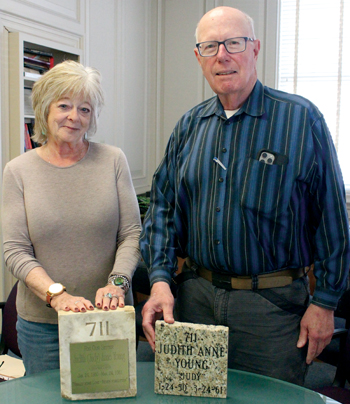
So Goins, who often paints and distributes her painted rocks, left placeholders at her sister’s burial site and dug up her stone. She wanted it to read more than just a number. Her sister was more than just a number.
Goins works at Grey Flex Systems in Coats. A coworker led her to Edgerton Memorials in Dunn. That’s where she met Cecil Edgerton.
“I love family history,” Edgerton said. “I’ve done a lot of family history so, to me, it just fit right in the way I was thinking. … This is something I would have liked to have done.”
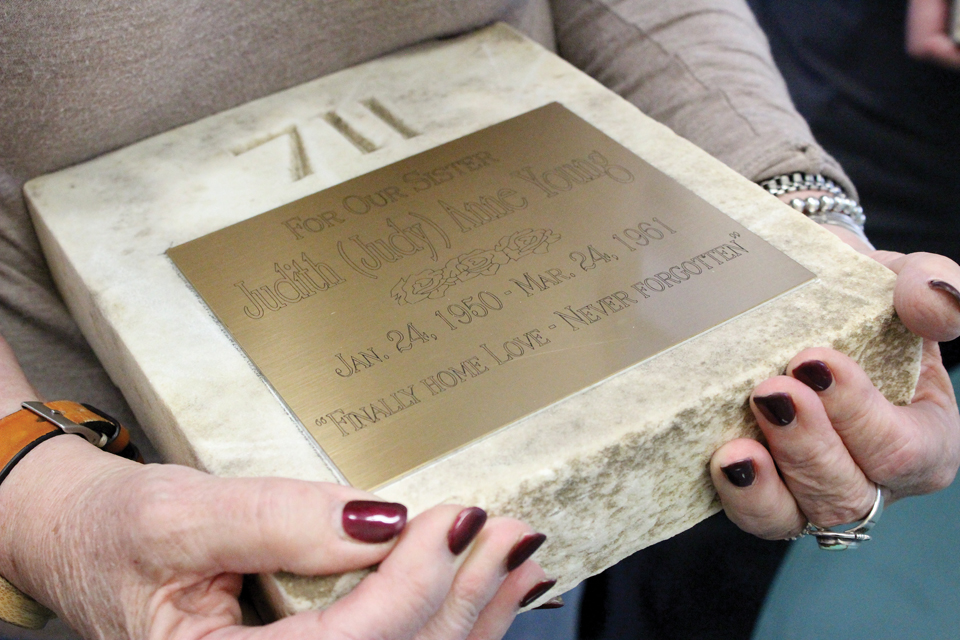
Edgerton was eager to help, but was nervous about etching into such an old, soft stone. He directed her to Frazee’s Trophies where Goins got an engraved plaque that reads:
For Our Sister
Judith (Judy) Anne Young
Jan. 24, 1950-Mar. 24, 1961
“Finally home Love – Never forgotten”
Edgerton helped her with a new stone to stand at the site of her sister’s remains so that Goins could place the original stone by her mother’s and brother’s graves which rest side by side in Ohio.
“This year, we are going up to Michigan on a trip and on our way back, we’re stopping in Van Wert so I can officially mount this” by their graves, she said, holding her sister’s original stone.
And on Memorial Day, Goins and the twins plan to return to the cemetery to hold a memorial service, honoring their loved ones who aren’t lost any more.
Goins is on a new mission now, to help anyone else who is searching for a lost loved one in the old Orient cemetery. There’s two less than 1,900 of them now.
POSTED: 05/22/26 at 8:55 pm. FILED UNDER: News