







Chapter by chapter: expanding the library
Editor’s note: This year the Brumback Library is celebrating 125 years of service to the community. Each month, the library will tell the story of the Brumback Library, chapter by chapter. This month’s installment explores the expanding Brumback Library. The story is told by Theresa Mengerink, Brumback Library Patron Service Specialist; content collected from Van Wert County Historical Society and Library files and The County Library by Saida Brumback Antrim.
By Theresa Mengerink
Amidst the mature shady trees adjacent to the city park, sits a structure resembling a miniature castle transported from Medieval Europe. The true strength of the Brumback Library has never been just its stone walls; instead, it is the library’s radical, pioneering mission.
As the very first tax-supported county library system in the United States, the Brumback has spent the last 125 years adapting, expanding, and occasionally packing up its entire collection to ensure the citizens of Van Wert County, whether living in Van Wert City or the furthest rural township, have free, equal access to the world of literature, technology, and information.
When it officially opened its doors in 1901, The Brumback Library housed a total collection of 6,572 volumes and served 2,713 local borrowers. At the time, the entire collection was contained within the footprint of what serves today as the main lobby, the Young Adult Room, and the Periodical/Book Sale Room.
Originally, these spaces featured bookshelves lining only the perimeter of the walls. However, as the community’s demand for reading materials steadily grew, the library had to adapt, eventually constructing additional bookcases right in the middle of the rooms to accommodate the influx of new literature.
This rapid growth eventually forced the library to expand vertically, leading to a major structural addition in 1913. A specialized balcony mezzanine was constructed directly over and behind the main circulation desk area to provide much-needed shelving space. In a striking architectural choice of the era, the floor of this new balcony was crafted from thick glass tiles, a design that served the dual purpose of maximizing vertical storage capacity while allowing natural light to filter down to the workspaces below.
In April 1917, the library took a definitive step toward fostering generations of future readers by opening its formal “Juvenile Department.” Rather than building outward, the library looked downward, remodeling its basement into a dedicated space specifically for youth. Under the passionate guidance of the library’s first youth specialist, Ella Bergert Conn, the modest basement room was transformed into a bustling hub of imagination.
As the main library on Main Street continued to serve as the nucleus for countywide operations, the administrative and storage demands of overseeing a vast network of rural branch libraries, at it peak 15 branches, began to strain the main building’s limits.
To alleviate the lack of space and preserve the architectural integrity of the historical building, the library board made a vital mid-century acquisition: a Brumback family home. Located on Jefferson Street, this property was repurposed as a specialized library annex. The Antrim Extension was the home of John’s daughter, Saida Brumback Antrim. The Jefferson Street annex served an essential dual purpose. It housed over 18,000 non-fiction volumes but operated primarily as the logistics and distribution center for library. Books were packed into stenciled, heavy gray wooden crates, secured with locks, and dispatched via the local train connects then later automobiles.
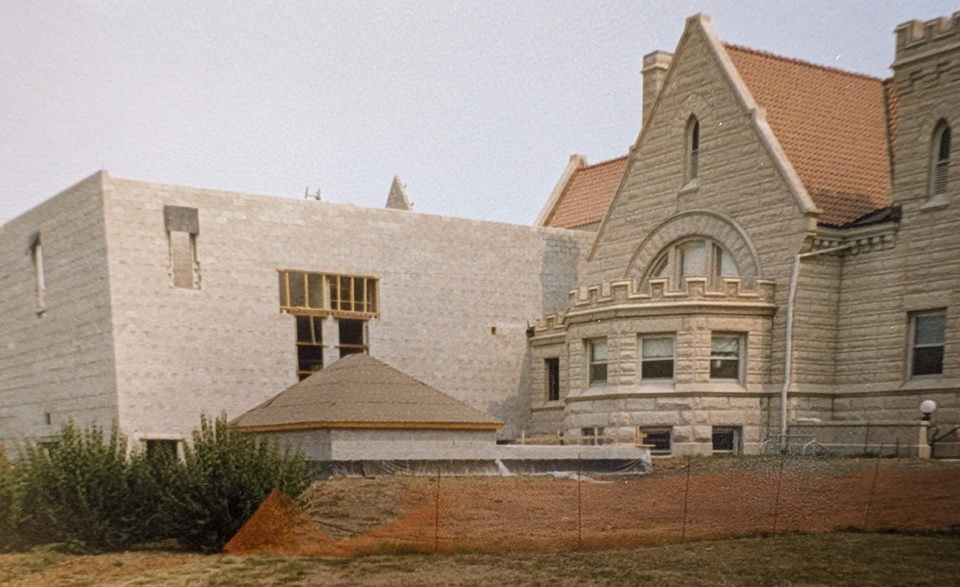
In the late 1980s it became apparent additional space would be needed to continue the mission of the library. The historic building needed comprehensive modernization to handle modern technology, and the library required far more physical space. A massive 10,500-square-foot expansion was greenlit, The Reed Memorial Addition. The addition was funded by a trust established by former board members Ellen Brumback Reed and her brother Orville Stanford Reed. The Reeds were grandchildren of John Sanford Reed. Miss Reed served on the library board as a representative of the Brumback family for 46 years until her death in 1989. The bequest stated, “this addition is to be a memorial to Estelle Brumback Reed, John Perry Reed and First Lieutenant Richard Brumback Reed, parents and brother of Ellen and Orville Reed”. Construction took about 18 months to complete.
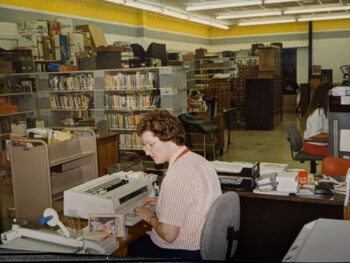
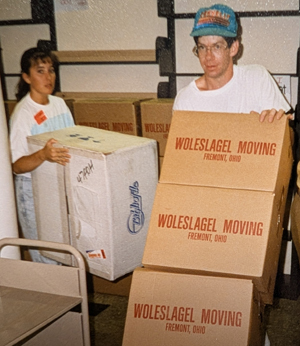
Executing a multi-million-dollar renovation on a historic sandstone structure required complete closure of the main facility. Yet, shutting down operations for over a year was out of the question for a community that relied heavily on its services. The solution was an ambitious, logistically dizzying compromise: the library packed up its massive collection and temporarily moved into a local strip mall. The Brumback Library found a temporary home in the building previously occupied by the Coast to Coast Hardware Store, in the Summit Shopping Center. Fluorescent lighting and commercial linoleum replaced the soaring wooden arches and historic masonry. The library was closed for a week to facilitate the move.
The temporary storefront setup kept the county connected while back on Main Street architects and construction crews meticulously blended the old with the new. When the library finally moved back into its renovated home in late 1991, patrons were greeted by a seamless expansion that perfectly matched the original Gothic-Romanesque exterior while adding state-of-the-art facilities inside. The limestone used in constructing the addition was cut from the same Bedford Stone Quarry in Bedford, Indiana, as the original building.
Today the library consistently ranks as one of the premier rural libraries in the nation. An Ohio Historical Marker was erected in 1981 to celebrate the library’s status as the First County Library in the United States. Now the institution is stepping into a new era of modernization. The Brumback Library Board of Trustees appointed Nellie Schmidt as the new Director of the Brumback Library in 2024. Schmidt, an experienced system librarian and library media specialist with two decades of expertise in public education, stepped into the role during a period of transformation. Under her leadership the library has continued to grow and flourish. The library has come alive offering new programs, resources, and technology to meet todays needs. Library patrons now have access to both physical and online books, audio books, and magazines from libraries across the state of Ohio. This new technology has helped further expand our collection without adding more physical space.
These recent updates represent merely the opening chapter of our future; the changes at the Brumback Library are just the beginning. We thrive to continue the radical, cutting-edge, and pioneering mission of John S. Brumback, honoring his legacy by looking forward. We are using our recent community survey to guide our next steps, we remain fiercely committed to making the Brumback Library a living, breathing resource for all citizens of Van Wert.
POSTED: 06/05/26 at 8:37 pm. FILED UNDER: News