







ODOT was prepared for early winter storm
DAVE MOSIER/independent editor
Winter came a little earlier than normal this year, but the Ohio Department of Transportation’s District 1 was prepared.
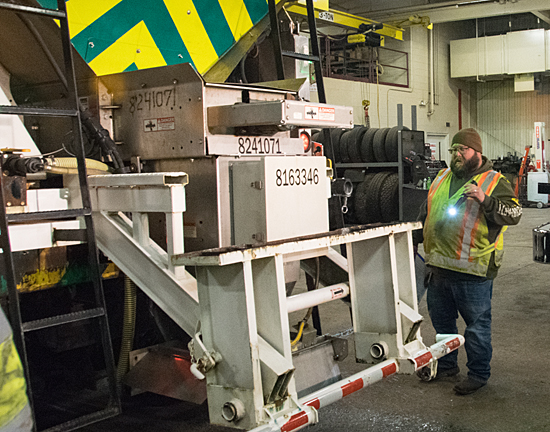
Chris Hughes, District 1 deputy director, noted during Thursday morning’s annual snow equipment inspection at the Van Wert ODOT garage that inspections mostly just confirm that each garage’s equipment is ready for winter, adding that District 1 garages were ready to go earlier this week when the first storm hit.
Hughes also noted that, while rock salt has been the main tool over the years for clearing roads of snow and ice, ODOT has been moving more toward the use of liquids — mainly salt brine — in recent years to cut down on costs.
While Van Wert County has been one of the heaviest users of brine over the past few years, Hughes said ODOT District 1 has also increased its use of bring on Interstate 75 as well, noting that Allen and Hancock counties will be using significantly more liquids on that highway this winter.
Many ODOT dump trucks also have side water tanks now to wet rock salt as it is spread on roads to ensure most of the salt actually stays on roadways.
“We’re paying a premium price for sale right now, so when salt gets dropped on the road and it bounces off into the ditch that’s money wasted.” Hughes explained.
Noting that ODOT is paying up to $77 a ton for salt, the District 1 deputy director said that is equivalent to the price per ton of asphalt.
“A dump truck full of salt, which will last you a matter of hours, is similar in cost to a dump truck load of asphalt, which you can use to repair a road that will last for years, and even decades,” Hughes said. “It’s a very valuable resource.”
One of the factors in the high cost of salt, he noted, is that the demand for rock salt has outstripped the ability of salt mines to supply it.
“It’s really a supply-and-demand thing,” Hughes said, noting that ODOT is looking at the feasibility of creating a strategic stockpile to help meet the annual demand, but that would involve constructing a facility to store the salt, since it can’t be stored outdoors: something that may — or may not — be cost effective.
“We’re still looking at that,” he said.
Furthermore, while brine is made from rock salt, it’s much more cost-effective, while also much easier to spread on highways.
The only problem with brine, Hughes said, is that drivers can’t get the heavy concentration needed for bigger snowfalls and ice storms.
“I don’t think we’ll ever get completely away from rock salt,” Hughes said, but also noted ODOT’s approach to salt use, as well as other operations, has gotten more scientific and data driven.
“It used to be years and years ago, it was much more of an art than a science; it was: through experience this is what you have to do,” he noted, adding that ODOT now collects data on salt use, and other operations, from GPS units installed on its trucks in an effort to be as cost-conscious as possible, while also continuing to provide its normal high-quality service.
“So we’re not just out there putting salt down when it’s not effective,” Hughes said.
The data-driven approach is also part of an internal ODOT initiative to save $100 million statewide in operational efficiencies over the next four years.
While Hughes said a recent state gasoline tax increase has provided needed funds for ODOT operations, he also added that ODOT officials want to be good stewards of that money as well, which means finding more cost-effective ways to spend it.
Hughes, who was at the Van Wert ODOT garage on Thursday morning to observe the equipment inspection, also commended county ODOT workers, noting that, while the inspection came soon after the snowstorm, the ODOT garage was clean and its equipment ready to go.
POSTED: 11/15/19 at 8:34 am. FILED UNDER: News