







Top stories of 2025: No. 2, No. 1
Editor’s note: As the end of 2025 is upon us, the Van Wert independent has been publishing a recap of what it judges to be the Top 10 stories of the year. Articles featuring two stories have been published daily, leading up to the top two stories being published today.
SCOTT TRUXELL/independent editor
No. 2 — A pair of tornadoes touched down in Van Wert County in early April and both were undetected on radar. While there was property damage, no one was injured or worse.
Late at night on April 2, a tornado touched down just south of the City of Van Wert. The twister continued to the northeast along an 11-mile path before crossing into Putnam County for a short distance, then dissipated.
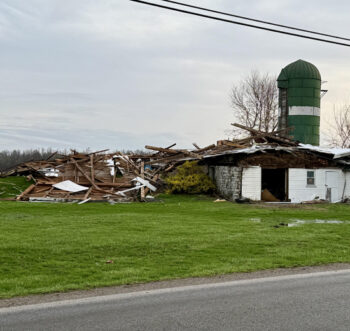
The National Weather Service rated the tornado an EF-1 twister with wind speeds of 95 miles per hour. Its maximum width was 300 yards and it was on the ground for nine minutes and traveled nearly 15 miles.
According to Van Wert County EMA Director Rick McCoy, numerous homes along the path had roof and siding damage along with some garages and outbuildings destroyed. There were also several barns destroyed, including barns on Peter Collins Road and Middle Point Rd. near Ohio 116, and a couple of grain bins were heavily damaged. A considerable amount of trees were uprooted or snapped along the path and power lines were down in a number of locations.
It was later determined that a second twister, a brief EF-1 tornado with peak winds of 100 miles per hour touched down near Glenmore. The tornado mostly moved through open fields but did snap a few trees and completely destroyed an outbuilding on Ainsworth Road, lofting debris up to 400 yards away.
No tornado warnings were issued ahead of the twisters. The National Weather Service Northern Indiana, which is based in Syracuse, Indiana, approximately 75 miles from Van Wert, is responsible for 37 counties, including Van Wert County. Warning Coordination Meteorologist Dustin J. Norman said the distance may have been a factor in no warnings.
“In a very favorable environment like we saw, these tornadoes spun up below the radar beam and would have only been more detectable if our equipment was closer to Van Wert,” he explained. “At this distance, our lowest radar beam is 5,000-6,000 feet above the ground, which causes inherent limitations.”
The two tornadoes put Van Wert County at 41 tornadoes since 1950, No. 1 in Ohio, giving the county the dubious title of “Tornado Capital of Ohio.” 36 of those tornadoes have occurred since 1990.

No. 1 — After months of speculation, the official word came in July – Van Wert Area Economic Development Corporation Executive Director Brent Stevens onfirmed that a data center is “100 percent” coming to approximately 220 acres at the Mega Site in Van Wert.
Citing a confidentiality agreement, Stevens declined to reveal the name of the developer or the company will run the data center. It was later confirmed that Thor Equities was the buyer of the property, but the name of the company who will own and run the data center may not be known until late 2026. The purchase price was not disclosed and it’s not known when construction will begin.
Stevens addressed concerns about the amount of electricity needed to operate such a facility and he noted it shouldn’t result in higher rates for electric customers.
“Where everybody in Van Wert gets their power from is not where they’re getting their power from,” Stevens explained. “It’s going to be coming down from the north. There are these big lines to the north of Van Wert, 345 kVs (kilovolts) and that’s where that power is going to be coming into, into a distribution station at the Mega Site.”
“When all this extra load comes into Van Wert, it actually does the opposite to rates and will potentially lower the rates, not increase the rates,” he added. “This is an all-AEP project and they will have supplementary power out there through generator systems, because they can’t allow the computers to go down, so they’ll have a generator that will kick on and they also may run those generators during peak hours.”
He also addressed concerns expressed about the amount of water required for cooling purposes at the data center.
“We have two million gallons of excess capacity (and) a lot of people have asked ‘is it going to drain our aquifer’” Stevens stated. “No, because we’re not going to take any water out of aquifer to supply this.”
The data center, which will house and operate computing hardware such as servers, storage devices, and network equipment, is expected to employ approximately 250 workers.
POSTED: 12/30/25 at 10:19 pm. FILED UNDER: News