







Distracted driving law working in Ohio
VW independent staff/submitted information
COLUMBUS — A new study released this week shows Ohio’s strengthened distracted driving laws are having some effect. It finds that drivers in the Buckeye State are less distracted behind the wheel when compared to the nationwide average.
The statewide analysis from Cambridge Mobile Telematics (CMT) shows that Ohio drivers tapped on their phones 7.2 percent less than the average U.S. driver. From January through December 2025, U.S. drivers averaged 23.6 phone taps per 100 miles, while Ohio drivers averaged 21.9.
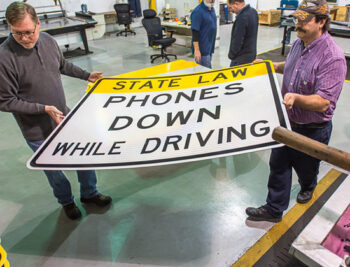
In 2023, Governor Mike DeWine signed a bill prohibiting all drivers, in most circumstances, from using or holding a cell phone or electronic device while driving on Ohio roads.
“A moment of inattention on the road can be all it takes to cause a devastating crash,” he said. “Although drivers in Ohio are keeping their eyes on the road more often than the nationwide average, I encourage more drivers to put their phones down as they travel. Nothing on your phone is worth risking your life for.”
While it remains legal for drivers in Ohio to have handheld phone calls while driving, CMT’s study found that handheld phone call rates in Ohio were five percent lower than the national average. From January through December 2025, U.S. drivers spent an average of 0.82 percent of their time on handheld calls, while drivers in Ohio spent 0.78 percent of their time on handheld calls.
“Every time a driver chooses to put their phone down, they are making our roads safer for everyone,” said Colonel Charles A. Jones, Patrol superintendent. “While our troopers continue to see the positive impact of this law through fewer crashes, our goal remains zero.”
Preliminary 2025 data shows traffic deaths fell percent compared to 2024, marking a fourth straight year of decline. The decrease in distracted driving is believed to be a significant contributing factor to this continued decline.
Methodology
CMT analyzed more than 189 million trips in 2025 using data from safe driving programs across Ohio. Its platform applies artificial intelligence to sensor data collected from smartphones, windshield-mounted tags, and other devices to detect risky driving behaviors, including hard braking, rapid acceleration, speeding, and distracted driving. These events are aggregated by time and location to produce actionable road safety insights. Tens of millions of drivers participate in these programs to earn safe driving discounts on personal auto insurance, saving U.S. drivers billions each year. All data is aggregated, anonymized, and contains no personally identifiable information.
County by County Analysis
CMT’s study also examined driving phone tapping and handheld call rates in each of Ohio’s 88 counties. 10 counties were above the national average in both categories: Adams, Butler, Cuyahoga, Gallia, Hamilton, Highland, Lawrence, Montgomery, Scioto, and Stark. Van Wert County came in lower than the nationwide average in both categories.
On average, drivers in Harrison, Meigs, and Hocking counties spent the least amount of driving time on handheld phone calls, while drivers in Adams, Highland, and Brown counties spent the most time on handheld calls.
“Ohio’s progress is worth celebrating. However, we still see too many drivers focused on their phones instead of the road. This puts travelers and our roadside workers at risk. So please follow the law and put your phone down to ensure everyone gets to their destination or home safely,” said Ohio Department of Transportation Director Pamela Boratyn.
Ohio’s Distracted Driving Law
Approved by the Ohio General Assembly and signed into law by Governor DeWine in 2023, Ohio’s distracted driving law makes it illegal to use or hold a cell phone or electronic device in your hand, lap, or other parts of the body while driving on Ohio roads. The law, which is a primary offense, allows law enforcement to stop a driver solely for a violation, without any other traffic offense occurring.
Drivers may still use hands-free technology, such as voice commands, dashboard mounts, or single-touch activation, but activities like texting, scrolling, or holding a phone are prohibited.
A first offense in two years includes two points assessed to a driver’s license and up to a $150 fine. Completion of a distracted driving course can help avoid the fine and points.
A second offense in two years results in three points assessed and up to a $250 fine. Three or more offenses in two years will get an offender 4 points on their license, up to a $500 fine, and the possibility of a 90-day driver’s license suspension.
Fines are doubled if the violation occurs in a work zone.
POSTED: 01/24/26 at 12:46 am. FILED UNDER: News