







Man thanks Middle Point Fire Department for rescue
SCOTT TRUXELL/independent editor
As the Thanksgiving holiday approaches, a local man has a lot to be thankful for and earlier this week, he took time to express gratitude to first responders who very well may have saved his life.
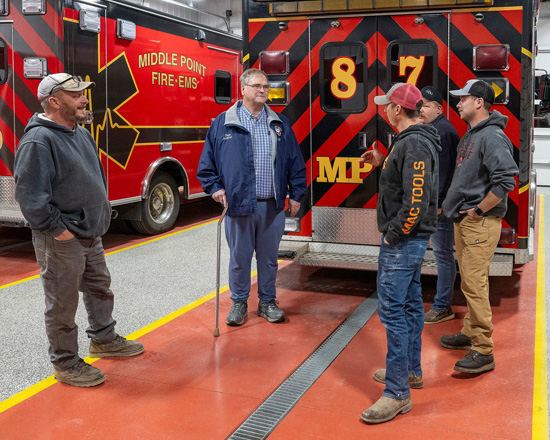
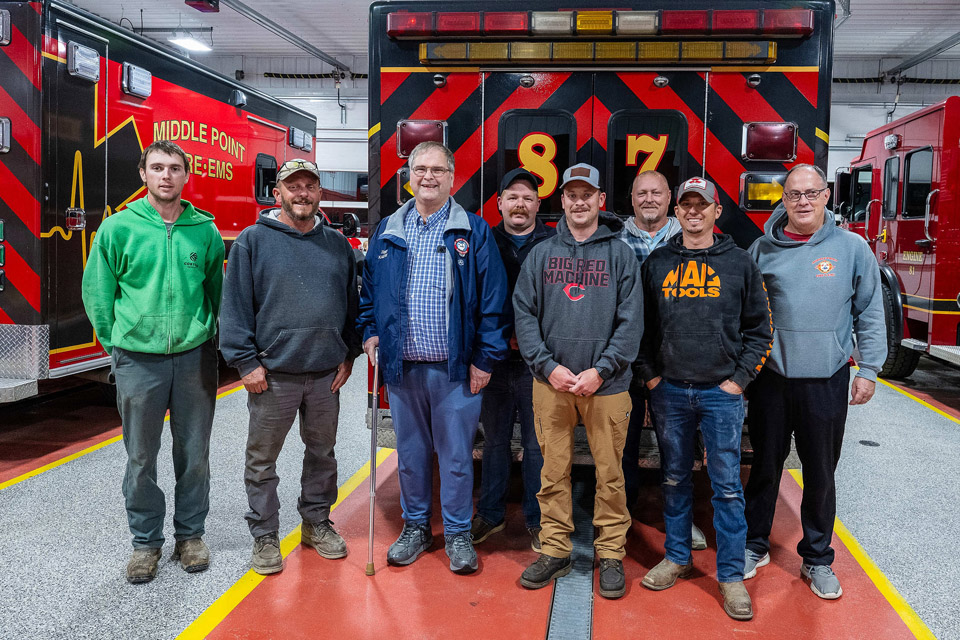
David Freels, 57, of Van Wert, and his wife Diana stopped by the Middle Point Fire Department’s Wednesday night association meeting and thanked members of the department and others involved in his rescue from a terrifying accident.
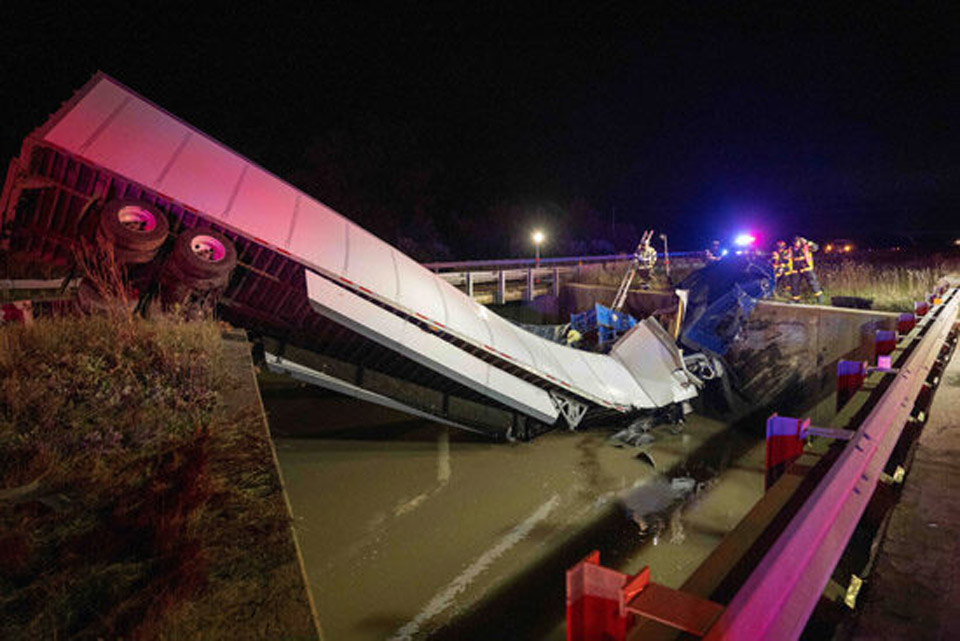
Shortly after midnight on September 22, a Kenworth semi-truck driven by Freels collided with a car in the westbound lanes of U.S. 30 at the Dog Creek Rd. bridge in Ridge Township. After the collision, the car went off the highway into the median, but the rig went into the median and struck a retaining wall before coming to rest in Dog Creek.
Freels suffered serious injuries but remained conscious throughout the ordeal and he said he remembers hearing cars go by but no one stopped, even though the back of his trailer was struck in the air and the car was visible from the median.
A bit later, emergency responders were dispatched and the Middle Point Fire Department was first on the scene. Firefighters immediately jumped into action and established contact with Freels.
“They were talking to me the entire time and we were trying different things and I was helping them in my limited capacity,” Freel explained. “I was pinned and I couldn’t move but I was digging the debris out from around me – everything that was under the sleeper bunk came up into the front of the cab and around me.”
According to Middle Point Fire Chief Brock Profit, the semi had been virtually destroyed, was extremely unstable, and was partially submerged in approximately four to five feet of flowing water. He added that Freels was pinned beneath the dashboard at the floorboard, with only approximately four to five inches separating him from the water below.
The semi had been hauling 700-pound steel crates that had shifted forward during the collision. The crates crushed the cab and passenger seat area. Above Freels and the rescuers, additional crates were stacked together like building blocks, creating a significant overhead hazard. Any unexpected movement could have resulted in further injury to the patient or rescuers working beneath them.
Extension ladders were used to reach the wreckage, with rescuers working from whatever stable surfaces they could find. Ratchet straps were first used to secure and bind the steel crates together, reducing the risk of catastrophic movement. Battery-powered extrication spreaders, cutters, and combination tools were then lowered into the work area and supported by rope systems operated by crews above.
Profit explained that crews began by spreading the driver’s side door and side of the semi to create a small access opening. That allowed rescuers to see the patient and begin assessing the potential injuries and challenges involved in removing him. Once the two rotator crane trucks arrived, they were put to work supporting the overhead steel crates. A rescuer was lowered from Ladder 2 using a rope system to attach lifting straps to the crates.
According to Profit, as the rescue progressed, it became clear that removing Freels through the driver’s side door was not going to be possible. Command and rescue crews made the decision to change tactics and move toward a slow, deliberate lifting operation. Using the two rotator cranes, crews successfully lifted and removed three of the 700-pound steel crates, creating access to what remained of the semi’s roof. Additional rescuers were then lowered onto the semi to begin removing the driver’s side of the roof and the corner post of the cab. The rotator cranes were again utilized to support the weight of the remaining cab structure as crews continued to work.
With enough of the cab opened, rescuers were finally able to secure a harness around Freels and a high-angle rope rigging system was established, allowing crews to lift him approximately six to eight inches. He was carefully placed onto a long spine board and then secured in a Stokes basket. A separate lower-and-haul rope system had been established and with Freels secured in the basket, rescuers were able to safely lift him up and out of the river.
The extrication process took approximately three hours and Freels was treated on scene by Middle Point EMS and Life Flight crews and prepared for air transport to Mercy Health-St. Vincent Medical Center in Toledo.
“My left arm was fractured and I’ve got a rod in there with about a dozen screws,” Freels stated. “I had multiple broken ribs from my seat belt and a bruised sternum. What’s holding me back is a fracture on the right side of my hip.
He was in the hospital for eight days and continues to recover from extensive injuries.
The driver of the car and five passengers, all from South Bend, Indiana, were transported by EMS to Mercy Health-St. Rita’s in Lima with critical injuries.
A number of local and area emegency responders ended up at the scene that night. The Ohio State Highway Patrol was assisted by the Van Wert County Sheriff’s Office, and the Middle Point Fire Department received mutual aid from the Ohio City Fire Department, Convoy Fire Department, Scott Fire Department, Delphos Fire Department, Van Wert Fire Department, American Township Fire Department, Ohio Department of Transportation, Hague Towing and Repair, Mercy Health Life Flight, Van Wert County CERT and Ohio Emergency Management Agency (EMA).
“I knew other departments had responded but I didn’t realize the extent of how many departments responded,” Freels said.
Profit said approximately 45 first responders worked together to accomplish the high-angle technical rescue and extrication.
“We train as much as we can, but some incidents present challenges that are difficult to fully prepare for,” he said. “This was one of those incidents. This was truly a team effort, and it is something our entire region can be proud of.”
Freels was quick to thank all of the first responders and agencies that flocked to the scene and provided assistance that night.
“Their efforts didn’t go in vain,” he said. “I’m up and walking and talking.”
POSTED: 11/13/26 at 9:39 pm. FILED UNDER: Top Story