







WBESC supt. defends public schools
DAVE MOSIER/independent editor
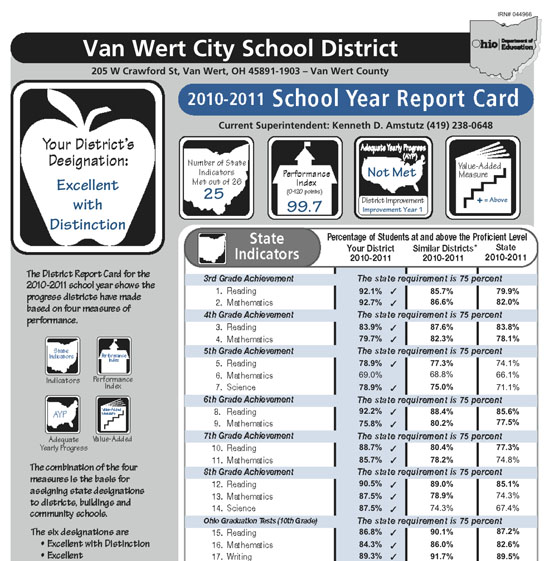
Western Buckeye Educational Service Center Superintendent Brian Gerber commended local school districts for their School Report Card results, but also took a swipe at charter schools’ mediocre results — especially with the money being spent by the state on those schools.
“Our parents, grandparents and community members in Paulding and Van Wert County can be very proud of their public schools,” Gerber said during the WBESC Governing Board’s December meeting, noting that all of those schools earned either an “excellent” or “effective” rating on 2011 School Report Cards. “Quite frankly, our public schools are exceeding expectations and outperforming charter schools … we outperform charter schools consistently and significantly.”
Gerber noted that charter schools, as a whole, produce dismal State Report Card results.
 “Although the Ohio General Assembly has spent $776,885,055.59 of Ohio taxpayer money for the promotion and support of charter schools, it is clearly evident from their performance on the 2011-2012 Report Card that this substantial investment has not produced many favorable results,” Gerber said.
The WBESC superintendent also provided statistics comparing public schools to charter schools on the School Report Card. Gerber noted that, while 23 percent of public schools were ranked as “excellent with distinction”, only 1 percent of charter schools were. Furthermore, a whopping 41 percent of public schools earned the state’s “excellent” rating, versus only 7 percent of charter schools. In the “effective” category, 28 percent of public schools met the criteria, compared to 16 percent of charter schools.
The difference shows up even more in the lower rankings of the State Report Cards. Only 6 percent of public schools were ranked as “continuous improvement,” compared to 27 percent of charter schools, while there were just 1.8 percent of public schools in the “academic watch” ranking, versus 15.6 percent of charter schools.
In the lowest ranking — academic emergency — just 0.2 percent of public schools earned that ranking, compared to 18.7 percent of charter schools.
In addition, another 14.7 percent of charter schools were not rated or exempt from the State Report Card rankings, versus none of the public schools.
The WBESC superintendent also noted that, while charter schools receive lots of money and little oversight, public school administrators and teachers face increasing mandates and decreased funding.
“Superintendents have to do more for less,” Gerber said. “They are consumed with managing finances because they know additional funding is not coming from the state and federal government. They also know that passing levies in this economy is an uphill battle.”
He also noted that the new state teacher evaluation requirements would require substantial time commitments from principals who are already overworked.
“Principals are gong to be forced to spend 80 percent of their time evaluating teachers,” Gerber told his board. “They do not have this luxury of time.”
Noting that principals “wear many hats,” the WBESC superintendent said the evaluation requirements will be a huge burden on those administrators.
“They have hundreds of students in their building and must deal with the unforeseen that comes their way on a daily basis,” Gerber added. “…they have to be involved with curriculum, intervention, school management, bus transportation, counseling and other mandatory required commitments.”
The WBESC superintendent also defended public school teachers, who are often criticized by state legislators for their students’ failure to do better on state standardized tests.
“Our public teachers cannot control their rosters; they have to teach everybody, with all different ability levels, unlike teachers in private schools,” Gerber stated. “We have great teachers who have needy students in their classroom. These needy students may not perform like straight-A students, but I guarantee that they made improvements throughout the year because they had teachers making sure of it.”
Gerber said he feels teacher evaluations should not be weighted toward student performance on standardized tests, noting that, in his own experience as a principal, he has had high-performing students do poorly on the standardized tests because of personal or other problems.
“Students attend school 177 days per year (and) they are given standardized tests three times a year,” the WBESC superintendent said. “It is ludicrous to evaluate a student or a teacher over three days of testing.”
Gerber said teacher evaluations should be comprehensive and balanced in all areas.
Also during the WBESC Governing Board’s December meeting, Treasurer Gary Ginter reviewed current financial reports, investments and monthly expenditures with the board, which approved the report later in the meeting.
The WBESC Governing Board’s next regularly scheduled meeting will be at 6 p.m. Wednesday, January 9, at the Van Wert ESC office at the Thomas Edison Center.
POSTED: 12/14/12 at 8:12 am. FILED UNDER: News