







Study: Arts impact regional economy
DAVE MOSIER/independent editor
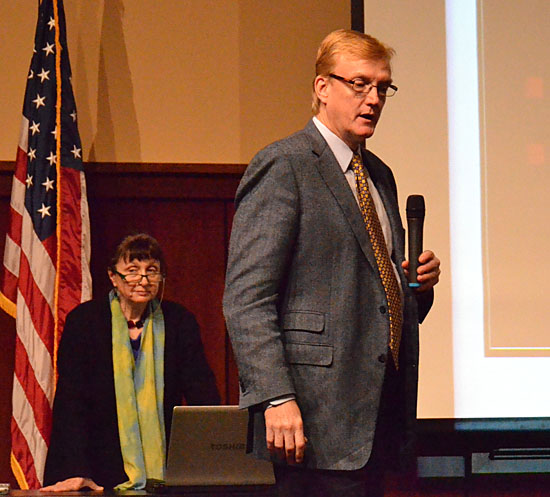
Although the numbers were somewhat outdated, the impact was not: The arts are big business in northwest Ohio.
Two Bowling Green State University professors, Dr. Michael C. Carroll, associate professor of economics, and Dr. Katerina Ruedi Ray, director of the BGSU School of Art, were in Van Wert on Tuesday to talk about a 2007 study the university conducted on the impact of the arts in northwest Ohio.
First of all, Carroll talked about just what comprised the term “the arts,” listing components that include museums and collections; performing arts; visual arts/photography; film, radio and television; design and publishing; and art schools and services. In total, businesses and organizations that make up those components created 33,500 jobs, generated $97 million in state and local taxes and $151 million in federal tax revenues for northwest Ohio.
Mostly, when people think of the creative economy or the arts-led economy, they are only looking at the smaller venues,” Carroll said, “but by the time you put in advertising and photographic services and all of those things, and you aggregate it in our 27-county region, it’s quite a bit of economic activity.”
Carroll also talked about the economic strengths of Van Wert County, citing the county’s stable economic structure, its strong manufacturing base, and its strong arts presence and activity. There was also a negative, though: the county’s aging workforce.
Although the BGSU professors did not break out numbers for Van Wert County, any numbers for the county would likely have lost their relevance by now, since the 2007 study doesn’t include revenues generated by the Niswonger Performing Arts Center, which didn’t open until the fall of 2007.
According to NPAC Executive Director Paul Hoverman, the performing arts center had 9,526 patrons and 11 shows its first year, which has grown to 23,925 patrons and 29 shows in 2012. More importantly for economic development, the percentage of out-of-county residents has increased from 29 percent in 2007 to 55 percent this past year.
Ray talked about how communities can promote the arts as a way of boosting economic development, citing Paducah, Ky., as an example. That city created a downtown renascence by providing relatively small economic incentives to lure artists to locate in downtown buildings in need of renovating. The improvements to those buildings, as well as new businesses and restaurants, increased property values tenfold — from $25,000 to $250,000, Ray said.
Promoting the arts also had other side benefits for the city’s downtown area, she noted.
“When the arts community takes over downtown,” Ray added, “you always have good music and good restaurants.”
Unfortunately, she added, the higher property values also ended the influx of artists to the downtown area, because the buildings became unaffordable to them.
Ray also cited Van Wert’s artistic assets, including the NPAC and Wassenberg Art Center, which is in the process of creating a larger and more flexible space in the former Van Wert Armory building.
Meanwhile, the BGSU professors said a new study updating the impart of the arts on northwest Ohio is currently being finalized, with Carroll predicting the study will show similar or even improved results compared to the 2007 study.
POSTED: 02/06/13 at 7:48 am. FILED UNDER: News