







Shooting fireworks
By Rex Dolby
With the promise of fireworks in the forecast, we thought we’d offer some tips that might improve your photographic results.
First, do some advance preparation and try to locate from where the fireworks will be shot and note the prevailing wind direction. This will allow you to be closer to the bursts and at an angle that will have the smoke drift away from you for a clearer sky. If possible, locate near an interesting building, statue, flagpole or the like that can be included in the foreground, with the bursts over or behind it. Try to set up in such a way that your view will be unobstructed and latecomers won’t park in front of you and block your view.
Use your early arrival time to check camera settings and to make sure the center post of your tripod is as vertical to the ground as possible. Its legs should be adjusted so that you can get your chair as close to it as possible. Bring extra batteries for your camera and flashlight. The light will come in handy if the camera’s settings need to be changed, as well as to check the area before you leave for anything that may have dropped unnoticed. Whether shooting film or digital, have plenty of media on which to record the many pictures you will take.
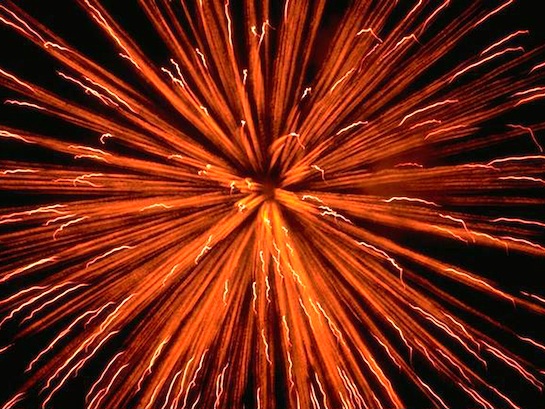
Set the camera to ISO 100 or 200 to reduce digital noise. Use manual settings because with the dark sky, the camera will want to overexpose the bursts. Set the aperture opening around f 8 with ISO 100 and f 11 with 200. Check some early shots (a digital camera advantage) for proper exposure. You may find that wider or tighter f-stops provide better results. Experiment with shutter speeds also. A slower speed will capture the trails from the burst and faster speeds will freeze the action. Depending on when you click the shutter, you may get the burst before it scatters much, or after it has scattered some.
To improve your timing, track the rocket as it rises in your LCD screen. If that isn’t an option, use both eyes. Have one in the viewfinder and the other beside the camera. Use a cable release to reduce camera shake. If that is not an option, form a C shape with your thumb under the camera body and your finger on the shutter release button. Simply reduce the size of the C to click the shutter and reduce the chances of camera shake.
You may want a zoom lens to give some flexibility in the impact of your pictures. Zooming in on individual bursts may fill the frame more and at finale time, backing off a bit may catch the magnitude of the show better.
We hope you have many great memories caught on camera that you can relive in years to come.
The Wassenberg Camera Club’s next regular meeting will be at 7 p.m. Thursday, July 11 at the Wassenberg Art Center. Landscape will be the competition theme that evening.
If you have any questions regarding our camera club, classes or programs or would like to sign up please call the Wassenberg Art Center at 419.238.6837, email info@wassenbergartcenter.org or register for classes online at wassenbergartcenter.org. Hours during exhibits are Tuesday through Sunday 1–5 p.m. The Wassenberg Art Center is located at 643 S. Washington St.
POSTED: 07/03/13 at 2:17 pm. FILED UNDER: Camera Club News