







Arson, insurance fraud convictions upheld
DAVE MOSIER/independent editor
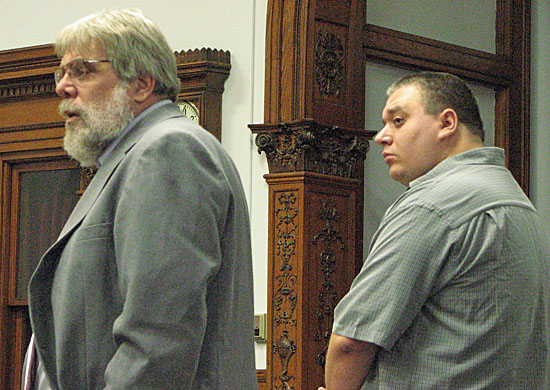
LIMA – The Third Ohio District Court of Appeals has unanimously upheld the conviction of a Van Wert man who set two fires at his Monroe Street residence in order to collect homeowner’s insurance claims.
John Plotts, 33, received the minimum prison sentence of three years each on two counts of aggravated arson, 18 months on a charge of insurance fraud, a fourth-degree felony, and six months on a misdemeanor arson count. The sentences are to be served concurrently.
The prison terms were handed down in connection with two fires Plotts was convicted of starting at his Monroe Street residence on April 8 and April 10, 2009, in order to collect insurance money. A jury deliberated an hour and 15 minutes before convicting him of the charges against him.
Although Plotts originally faced sentencing on a total of six arson charges – three counts apiece for each of the two fires – Judge Charles D. Steele noted at the man’s sentencing that state guidelines mandated that he combine the three arson charges for each fire into one aggravated arson count, which reduced the felony arson charges to two.
In addition, Judge Steele overruled Assistant Prosecutor Kevin Taylor’s recommendation that Plotts be given consecutive sentences and not be allowed free on bond while his case was under appeal.
Plotts’ appeal included two assignments of error he felt should lead to the conviction being set aside. The first error was that a chain of evidence was not established for all of the physical evidence. Plotts also claimed that his first attorney, Gene Murray of Fostoria, did not provide adequate representation to his client during the case.
Plotts had retained Lima attorney William Kluge by the time he was sentenced on July 28, 2010.
Presiding Judge Richard Rogers, in writing the decision for the appeals court, discussed Plotts’ first assignment of error, which basically stated that investigators didn’t do an adequate job of proving that only Plotts could have had some of the evidence in the case in his possession.
Rogers cited State vs. Wilkins, a 1980 case decided by the Ohio Supreme Court, which noted that a “strict chain of custody is not always required in order for physical evidence to be admissible (and that) the state need only establish that it is reasonably certain that substitution, alteration or tampering did not occur.”
The judge ruled in his decision that testimony at the trial “set forth a sufficient chain of custody,” and noted that anyone entering the residence after the fire did so to either investigate the cause or survey the damage. Those people who did enter testified they removed nothing from the residence, while several witnesses testified that the house was locked when there was no one there.
“In light of the following, we find that the State, with reasonable certainty, established that no substitution, alteration of tampering occurred with regard to the physical evidence presented at trial,” Judge Rogers concluded.
In overruling Plotts’ claim that his first attorney failed to represent Plotts adequately during his June 2010 trial, the appellate court laid out the factors needed to substantiate that error, concluding that, although Murray did not use an expert to refute claims about prosecution experts, his actions on that and other aspects of the trial were a matter of trial strategy, not proof that the Fostoria attorney’s representation was at fault for Plotts’ conviction.
Judges Stephen Shaw and John Willamowski concurred with Rogers on the decision.
POSTED: 03/03/11 at 4:54 am. FILED UNDER: News