







Double exhibit opens at Wassenberg
By Hope Wallace
If you visit the Wassenberg Art Center between now and May 7, you’re in for a double treat — two unusual exhibits, “It’s In the Cards” and “The Art of Therapy” opened on Sunday, April 3, with a reception that drew a large crowd of visitors. Live, original, acoustic guitar music was provided by Van Wert High School sophomore Treig Pierce and friends. The exhibits will run through May 7, 1-5 p.m. Tuesday through Sunday (closed Mondays). Admission is free. Vancrest Health Care Center is the sponsor.
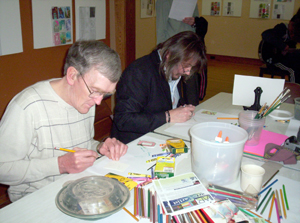
“It’s In the Cards” displays hundreds of Artist Trading Cards (ATCs), an art phenomenon that allows anyone to exchange baseball-card-sized original works of art. You’ll be amazed at what people can do with a 2 1/2 x 3 1/2 inch card. Just about any kind of art can be used on an ATC, and anyone can make one! You can make your own ATC in the front gallery — paint, colored pencils, crayons, collage materials, pencils and markers are provided, along with a good supply of blank cards. Press hard, get messy, and color outside the lines!
Our main gallery features “The Art of Therapy.” It includes work by both local and out-of-state artists, with a broad line of abilities on display. Works by artists from Vancrest Health Care Center, Bittersweet, Inc., and other individuals are included. For most artists, art is a secondary language that persuades us to look at the world with fresh eyes, helping us to see we are all much more similar than different. These artists’ challenges are diverse as is the outcome of their wonderful gifts.
Bittersweet Farms in Whitehouse has been serving individuals with Autism Spectrum Disorders (ASD) for over 25 years. Art is just one of the many programs at Bittersweet, and it is both beneficial and an aid to communication for these artists.
The artists of Vancrest Health Care Center in Van Wert have provided 28 works in tempera using an unusual technique called MnemeTherapy™. This therapy uses everyday pleasures such as singing, movement, painting and storytelling in combination; it benefits a wide range of people in numerous ways.
Other works include art by Val Sluterbeck of Van Wert, photography by Will Hawkins of Van Wert, and drawings by Bruce Dellinger of Timberville, Virginia.
The Wassenberg Art Center is located at 643 S. Washington Street in Van Wert, Ohio. Contact us at 419.238.6837, wassenberg@embarqmail.com, or visit the website at www.vanwert.com/wassenberg.
Herblock lampooned the mighty
By Kay Sluterbeck
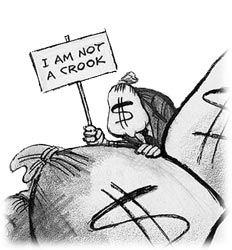
Photo caption: Cartoon by Herblock.
“The political cartoon is not a news story and not an oil portrait. It’s essentially a means for poking fun, for puncturing pomposity. Cartooning is an irreverent form of expression, and one particularly suited for scoffing at the high and mighty. If the prime role of a free press is to serve as a critic of government, cartooning is often the cutting edge of that criticism.” — Herbert Lawrence Block, commonly known as Herblock (1909-2001).
No editorial cartoonist has made a more lasting impression on the nation than Herbert Block. Using humor to draw people in to read the cartoons and consider his opinions, he delivered strong messages and often awoke both
the public and politicians to threats both from abroad and at home.
His first cartoon was published in the Chicago Daily News around 1930, when a temporary summer job replacing the editorial page cartoonist quickly became a permanent one. During the course of his career he won three Pulitzer Prizes, the Presidential Medal of Freedom, the National Cartoonist Society Editorial Cartoon Award (twice), the Reuben Award, and the Gold Key Award (the National Cartoonists Society Hall of Fame). His editorial cartoons were the subject of exhibitions, books, and displays at the Library of Congress. He also received the Elijah Parish Lovejoy Award as well as an honorary Doctor of Laws degree from Colby College.
He was on the forefront of every threat to liberty, peace, and justice. At a time when the American public and politicians were turned toward isolationism, Herblock brought the activities of Hitler, Mussolini and Franco to their attention, exposing the threats of Fascism in Europe. One of his simplest and most powerful cartoons showed a Nazi cap extinguishing the light of German civilization.
The period from the late 1940s to the late 1950s became known as the Second Red Scare, a time characterized by heightened fears of communist influence and espionage. Senator Joseph McCarthy exploited these fears by causing thousands of Americans to be accused of being Communists or communist sympathizers. The term “McCarthyism” came to represent accusations of disloyalty, subversion or treason without proper regard for evidence. Those accused — often on laughable reasons — had to go through aggressive investigations and questioning by both governmental and private groups. Even if evidence was inconclusive or questionable, hundreds of people lost their jobs, had their careers destroyed, or were even imprisoned. Most of these punishments came out of trial verdicts which were later overturned, laws that were eventually declared unconstitutional and other procedures which came into general disrepute.
Herblock vigorously attacked McCarthyism, portraying McCarthy as an unshaven, belligerent caveman-type in a suit. His caricatures hit their mark. Columnist Walter Winchell commented to a friend that he had come upon Senator McCarthy shaving at midday, complaining that he had to shave twice a day on account of Herblock’s cartoons.
Richard Nixon had a similar reaction when the cartoonist attacked the political abuses and scandals of his administration. At one point Nixon said that he had to “erase the Herblock image.” Nixon canceled his subscription to the Washington Post after Herblock drew him crawling out of an open sewer. The cartoonist won his third Pulitzer Prize in 1979 for his cartoons about Nixon’s activities.
Herblock’s style was clear, concise, and compelling, using few words to get his point across. A characteristic feature of his cartoons was a distinctive geometric border of 45 degree angles and parallel lines along two sides of the cartoon, making the cartoon appear to be drawn on the top surface of a block rather than sketched on a flat sheet of paper.
For the better part of a century Herblock’s work helped expose and ward off the effects of bigotry, war, political arrogance and social injustice, and he never stopped trying to bring these evils to public attention. His last cartoon was published on August 26, 2001. He died of pneumonia six weeks later at the age of 91.
POSTED: 04/06/11 at 12:59 pm. FILED UNDER: What's Up at Wassenberg?