






Sneak preview for Niswonger Scholars
The 55th annual June Art Exhibit happily opened a little bit early this year for a very good reason. On June 2, we enjoyed a visit by 12 of the Niswonger Foundation Scholars during their tour of Van Wert. It was truly a pleasure to have these gifted people get a firsthand look at the levels of ability tucked away in the corners of small, rural communities. What better example than the Annual June Art Exhibit to illustrate this
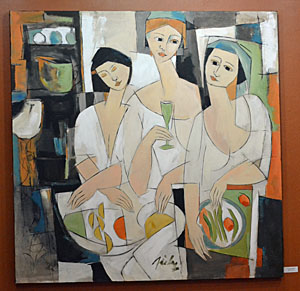
This year’s show contains around 150 pieces of art, both two- and three-dimensional, primarily from area artists, although several pieces come from out of state.
The Niswonger scholarship requires the recipients to return to their home towns and give back some of what they have learned being a Niswonger Scholar. If being in the Wassenberg Art Center spawns just one idea of creating an art center in a town that doesn’t have one, that is a day’s work well done. Spreading the concept that art is our culture and is what identifies us as who we are, where we come from and how we roll, is paramount to creating a strong community.
We at the Wassenberg Art Center offer our heartfelt congratulations to our award winners and honorable mentions for this year’s June Art Exhibit! Thank you for sharing your hard work and creative vision with us. We are truly flattered you chose to submit your work.
And a big “thank you” to all who bid on our beautiful hand-painted chairs for this years “Chair-ity” Auction. We truly appreciate your support and interest in getting a cool chair and obvious conversation piece. We look forward to presenting you with new designs and concepts next year!
Remember, everyone is invited to the big Reception and Awards Cookout at the art center on Saturday, June 11, 5-9 p.m., to celebrate the June show winners and the 50th anniversary of the Main Gallery addition. Music by John Reichle, barbeque by Wild Hare BBQ, homemade sides and craft beer! There is a small entry charge for the public and everything is first come, first served. Artists participating in the exhibit get in free.
The Wassenberg Art Center is located at 643 S. Washington St., Van Wert, Ohio. Contact us by phone at 419.238.6837 or email wassenberg@embarqmail.com. Visit the website at www.vanwert.com/wassenberg.
Ancient subject still challenges artists
By Kay Sluterbeck
From prehistoric times to the present day, artists have returned to one subject again and again. It has been scratched on cave walls; carved from riverbank mud; painted and drawn and sculpted in every conceivable medium, and even now the human form is still one of the most fascinating and rewarding subjects any artist, amateur or professional, can draw.
It’s natural to want to sketch, paint and sculpt people. We see people every day, and their forms and actions are very familiar to us. Throughout history artists have found that the human figure has possibilities for expression that aren’t provided by any other subject. A quick glance through any collection of art masterpieces makes it obvious that artists have found the human figure, whether clothed or nude, one of the most intriguing subjects to tackle.
There are several ways to depict the people. Many artists specialize in portraits. Portrait painting usually concentrates on realism. The artist wants to make a portrait that is a good likeness and captures the personality and mood of the subject. Even in stylized, caricatured or abstract portraits, you can recognize the person depicted.
The portrait doesn’t have to be just a picture or sculpture of someone’s head and shoulders. It can include a partial or full-length view of the figure. A portrait may be formal, with the subject or subjects wearing their “Sunday best”, or informal, with children dressed in play clothes and adults in casual dress. Portraits can show the person fully clothed, draped, or nude.
Portraits sometimes make comments on the individual portrayed. For example, many 1700-1800s-vintage sculptures depict famous people wearing togas. By sculpting someone such as George Washington in a toga, the artist is comparing their wisdom and dignity to the emperors and philosophers of ancient Rome. Portraits can also be a means of negative political comment, as when artists create pictures or sculptures of famous people in a way intended to make them look undignified or silly.
The human figure in art is often a symbol, standing for things that no other form or shape could convey. An artist can create a figure that is obviously not a realistic portrait and use it to say something. The Statue of Liberty is a good example; with a strong and dignified woman representing the idea of Liberty.
The statues carved by the ancient Greeks weren’t realistic copies of models. They were idealized people invented by the artist to show his concept of perfect beauty. It was a way to say “This is what I think the ideal human being would look like, a combination of perfect proportions, grace and rhythm.” Because such perfection can’t be found on earth, these figures were superhuman, having the quality of gods and goddesses. The Greeks represented the ideal world by perfecting the real things they saw around them.
On the other hand, medieval artists weren’t after physical beauty. They wanted to show spiritual ideals. To the medieval artist, the physical world was a difficult and unpleasant place to live, and it was only temporary. To these artists, Heaven was their home, and therefore their art celebrated the beauty of the soul instead of the body. Medieval artists used human figures to show abstract concepts such as love, humility, devotion, and self-restraint. This is why many medieval figures appear distorted, with elongated bodies and stiff, formal poses. We look at them and realize that these people are not of this world, but of a spiritual world.
During the Renaissance, people rediscovered the beauty of nature. People were happy to be human, and the artists of the time wanted to show the human body realistically and at its best. The human figure became the subject of intense scrutiny as artists examined how bones, tendons, muscles, and flesh work together. Painters and sculptors enjoyed creating the look of rippling muscles, beautiful skin tones and texture, and the play of veins under the skin.
Today, anything goes. Human figures are depicted both realistically and expressionistically. Some artists clothe their figures; others paint nudes. Some distort the figure to express a mood or message and some concentrate on pure design, making the figure almost unrecognizable. Others paint with absolute realism right down to the tiniest eyelash. Some work in the middle of these two extremes.
Artists today have a freedom of expression that is absolutely unique in recorded history. There are many ways to be human, and today’s art has many ways to show this. Now, when we look at art depicting the human form, we have a richer, more perceptive experience than any viewers before us.
POSTED: 06/14/11 at 10:01 pm. FILED UNDER: What's Up at Wassenberg?