







Photographing sunsets
The Wassenberg Camera Club will meet Thursday, June 9, at 7 p.m. at the Wassenberg Art Center at 643 S. Washington Street in Van Wert.. “Sunsets” will be the competition theme in prints and slides that evening.
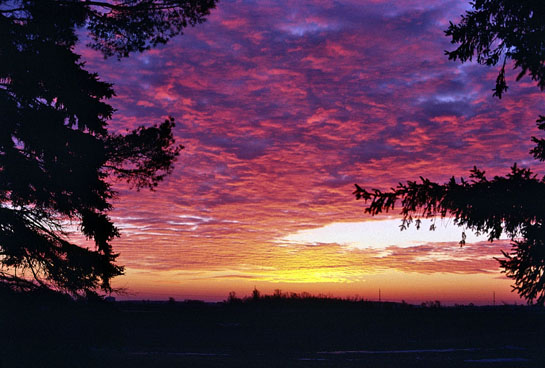
Now that the farmers are in the fields, the dust they make, or particles from a forest fire, or a volcanic eruption can create some spectacular sunsets. Check the forecast and watch the sky for developing clouds that might provide surfaces for the sun to color or to hide the sun to create sun rays. Sometimes when you are traveling west you will see a sunset begin to develop. If possible, find a place along the road that has an interesting tree, rock formation, building or body of water that you can place in the foreground to make the picture more interesting. At home, have such a place already in mind that will not only provide the foreground interest, but also enables you to follow the path of the sun below the horizon.
Often the sky is the most colorful just before or just after the sun drops below the horizon. For below the horizon shots, slightly under expose the scene. It will make the colors more vivid and the foreground, which should only be a third of the picture or less, more in silhouette.
Use your lowest ISO setting to reduce noise in the dark areas. This may mean you’ll need to put your camera on a tripod to make a longer, sharper exposure.
Using a body of water, even a large mud puddle for a sky reflector can add much to the picture. The lower to the water you can get, the more the reflection will be in the picture. Note that before sunrise and after sunset will produce the calmest surfaces for reflections. There will be wind currents present to some degree as long as the sun is above the horizon to ruffle the surface. .
Although including the sun in the composition may provide just the touch you want, there are some technical hazards to be aware of that are not present when the sun is below the horizon or behind a cloud, trees, or whatever.
One is the bright spot in the sky where the sun is. It is easy to overexpose this area while trying to get the rest of the sky right. Under exposing the area may solve the brightness problem, but the rest of the sky may be too dark.
Another problem is the danger to your eyes from looking at the sun for extended periods, or looking through the viewfinder where the sun’s rays have been concentrated by the camera’s lens. Forget the viewfinder and use the view screen. Should you be using a film camera with a cloth shutter, it is possible to burn holes through the shutter — at least it happened to me while trying to directly shoot a solar eclipse.
If the scene is quite impressive, you may want to consider taking a series of horizontal pictures (tripod preferred) and stitch them together for a panoramic view. An aid for a so-so scene due to lack of color is a warming filter. Often the view through such a filter provides just enough of a color boost to create a very respectable image.
There should be a huge number of images brought to the competition and visitors are invited to feast their eyes on a great show.
POSTED: 06/14/11 at 10:07 pm. FILED UNDER: Camera Club News